Dyestuff industry experts
ITMA AISA 2026



- Home
- About
- Online Q & A
- Products
- Applications
- Solution
- Service
- Our Brand
- Info
- Contact
Views: 16 Author: Site Editor Publish Time: 2026-03-27 Origin: Site


You make disperse dyes for textile printing through the careful preparation and synthesis of disperse dyes, ensuring safe handling throughout the process. High-quality disperse dyes provide vibrant colors and exceptional durability, particularly on polyester fabrics. Research indicates that these dyes enhance print sharpness and longevity. Trusted companies like TIANKUN CHEM ensure you achieve consistent, excellent results every time. Always adhere to safety protocols and follow best practices in your work. The global textile market relies on disperse dyes for their strong color and outstanding performance.
Application Type | Key Insights | |
|---|---|---|
Textile | 71% | 74% of polyester fabric dyeing utilizes disperse dyes, and 63% of all textile exports require synthetic fiber coloring. |
Printing Ink | 9% | 54% of textile printing employs disperse dye inks, and 48% of digital printing relies on these inks. |
Others | 6% | 51% of these applications occur in factories, with specialized dyes for unique requirements. |
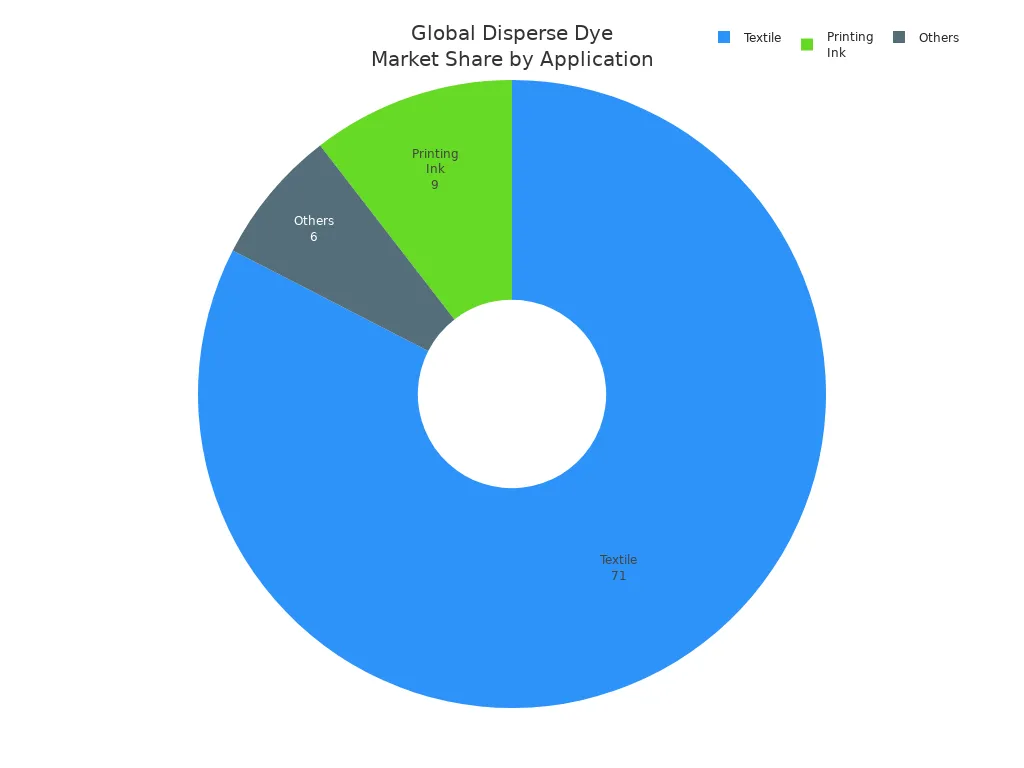
Quality disperse dyes enhance color brightness and longevity, which is crucial for producing clear prints on polyester.
The rising demand for digital printing has led to an increased need for specialized disperse dye inks that create vibrant prints.
Fashion designers are seeking new colors, prompting companies to develop innovative dye types for a broader palette and more intense hues.
There is a growing demand for dyes that offer extended durability and can withstand challenging conditions, particularly for sports apparel.
The preparation and synthesis of disperse dyes for textile printing require skill and diligence to maintain high product quality.
Disperse dyes help make polyester fabrics bright and strong. They improve how prints look and last longer.
Safety matters when using chemicals. Always wear safety gear. Work where air moves well.
Getting fabrics and dye baths ready is important. This helps colors turn out even and bright.
Digital printing with disperse dyes lets you change designs fast. It also uses less water and energy.
Checking quality at each step is important. This makes sure dyes meet color and stability standards.
Using good disperse dyes from trusted suppliers like TIANKUN CHEM gives steady results. It keeps customers happy.
Change dyeing methods for different fabrics. Each fabric needs special care for the best results.
Test dye performance often. This finds problems early and keeps colors strong and lasting in textile printing.
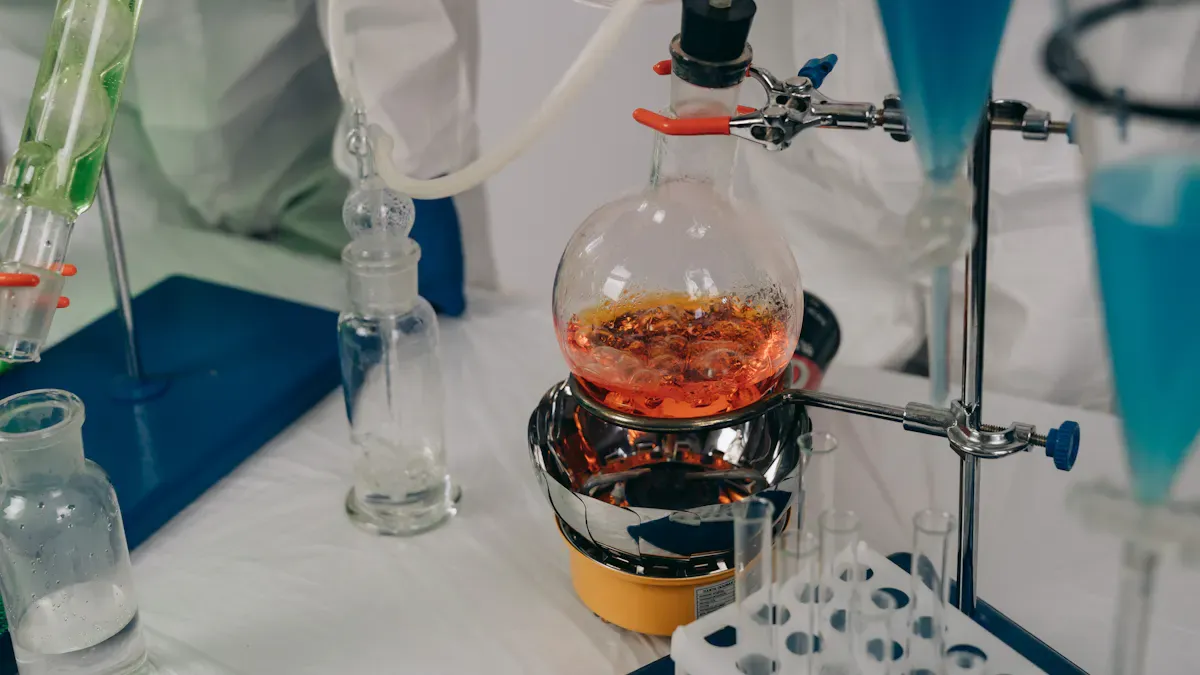
Image Source: pexels
Making disperse dyes for textile printing takes careful work. You must follow each step to make sure the dyes work well on polyester. This process helps you get bright colors and strong prints that last. Using high-quality disperse dyes gives you better results in textile printing. TIANKUN CHEM uses advanced ways and strict checks to make sure every batch of dyes is good.
You need different chemicals and tools to make disperse dyes for textile printing. The main chemicals are aromatic amines, phenols, nitro compounds, and coupling agents. You also need solvents like water, ethanol, or acetone. For making the dyes, you use glass beakers, flasks, stirrers, thermometers, and filters. You might also need a heating mantle and a pH meter. These tools help you control the reaction and make sure the dyes form right.
Chemical Type | Example | Purpose in Synthesis |
|---|---|---|
Aromatic Amines | Aniline, p-nitroaniline | Used as starting materials |
Coupling Agents | Phenol, naphthol | Help form dye molecules |
Solvents | Water, ethanol, acetone | Dissolve and mix chemicals |
Acids/Bases | HCl, NaOH | Adjust pH during reactions |
You must use clean and dry tools. This stops contamination and keeps the disperse dyes good.
Safety is very important when making disperse dyes for textile printing. You should always wear gloves, goggles, and a lab coat. Work in a place with good air or use a fume hood. Some chemicals can hurt you if you breathe them in or touch them. Always read the safety data sheets before you start. Keep a fire extinguisher and first aid kit close by. Throw away waste chemicals the right way to keep yourself and the environment safe.
Tip: Always label your chemicals and store them safely. Never eat or drink in the lab.
Making disperse dyes has several main steps. Each step helps you build the dye and get it ready for textile printing.
You start by making intermediates. These are simple chemicals you use to build the final dye. For example, you might reduce a nitro compound to make an aromatic amine. You may also make phenols or other chemicals. You need to watch the temperature and pH during this step. This helps you get pure intermediates for the next part.
Next, you use the intermediates in coupling and condensation reactions. You mix the aromatic amine with a coupling agent like phenol under controlled conditions. This makes the main part of the disperse dye. You may need to change the pH to speed up or slow down the reaction. Sometimes, you use heat to help the reaction. The goal is to make a dye that sticks well to polyester fibers.
Recent advancements in disperse dye technology include the development of a thixotropic adjustable disperse dye ink for direct inkjet printing on polyester fabrics without the need for pretreatment. This innovation addresses the common issue of ink bleeding during printing, allowing for high-resolution patterns without external stimuli such as heat or UV light. The study introduces a unique ink formulation that utilizes diethylenetriamine (DETA) to create a non-Newtonian fluid, which significantly suppresses ink bleeding and enhances print quality.
TIANKUN CHEM uses modern ways to make sure the dyes have strong color and do not fade. You can trust that each batch is checked for quality.
After the main reaction, you need to clean the dye. You filter the mix to take out any solid bits. You may wash the dye with water or another solvent to remove leftover chemicals. Sometimes, you use crystallization to make the dye even cleaner. Once you have a pure dye, you dry it and put it in a sealed container. Keep the dyes away from light and moisture. This helps the dyes stay good and ready for textile printing.
Note: Quality control is important at every step of making disperse dyes for textile printing. You should test each batch for purity, color strength, and stability. This makes sure the dyes work well in textile printing and meet what customers want.
Making disperse dyes for textile printing is a detailed process. When you follow each step, you can make dyes that give bright, lasting colors on polyester. TIANKUN CHEM’s skill and strict checks help you get the best results in textile printing.
You want your textile prints to look bright and last a long time. TIANKUN CHEM disperse dyes help you reach this goal. These dyes give you strong, vibrant colors on polyester fabrics. You will see that your prints do not fade easily, even after many washes. The dyes spread evenly on the fabric, so you get smooth and clear designs every time.
You can trust these disperse dyes for their high colorfastness. This means your colors stay true under sunlight and after washing. Many customers use these dyes for sportswear, fashion, and home textiles. They share stories about how the colors stay bright and the prints look new for a long time.
"I use TIANKUN CHEM disperse dyes for my polyester products. The colors always pop and my customers love the quality," says a textile producer from Morocco.
You care about the environment. TIANKUN CHEM disperse dyes meet strict environmental rules. The company uses safe methods to make these dyes. You will not find harmful chemicals in the final products. These dyes pass tests for safety and eco-friendliness.
The dyes help you follow green practices in your factory. You can use them with confidence, knowing they do not harm people or nature. Many brands choose these dyes because they want to protect the planet and meet global standards.
Feature | Benefit for You |
|---|---|
Low toxic residue | Safer for workers and users |
Meets global standards | Easier export and compliance |
Clean production | Less waste and pollution |
You can use TIANKUN CHEM disperse dyes in many ways. These dyes work well for dyeing, printing, and even digital printing on polyester. You can use them for flags, banners, sportswear, and fashion items. The dyes adapt to different machines and methods.
If you want to try new printing techniques, these dyes support your creativity. You can use them for both small and large batches. Many factories use these dyes for both traditional and modern textile printing. You will find that the results stay consistent, no matter the method.
Tip: Try using disperse dyes for digital printing. You will see sharp images and bright colors on polyester fabrics.
You can rely on TIANKUN CHEM disperse dyes for quality, safety, and flexibility. These dyes help you create products that stand out in the market.
You need to pick the right fabric before dyeing. Each fabric type needs special steps to help disperse dyes stick well. Polyester is best for dyeing polyester fabrics because it soaks up dyes deeply. Cotton does not need much pretreatment, so prints stay clear and soft. Silk is delicate, so you must use gentle pretreatment at lower heat. Blended fabrics need you to change settings based on the main fiber. For example, use cotton settings for cotton-polyester blends.
Fabric Type | Recommended Pretreatment Method |
|---|---|
Cotton | Needs less pretreatment with a thin layer for clear prints and soft feel. |
Polyester | Needs high heat and longer curing time for deep dyeing. |
Silk | Needs gentle pretreatment at low heat because it is delicate. |
Blended Fabrics | Change settings based on the main fabric; use cotton settings for cotton-polyester blends. |
You should clean the fabric by scouring and bleaching. This takes away dirt and oils that stop dyes from going into the fibers.
You must get the dye bath ready to dye evenly. Start by cleaning the fabric. Use scouring and bleaching to take out dirt. Keep the temperature between 60°C and 100°C. This helps disperse dyes stick to the fabric. Make the bath a little alkaline with sodium carbonate. This makes colors brighter and stronger. Stir the dye bath well and add leveling agents. These agents help dyes spread and stop patchy spots.
Clean and get the fabric ready before dyeing.
Keep the temperature between 60°C and 100°C.
Make the pH a little alkaline with sodium carbonate.
Stir the dye bath and use leveling agents for even color.
Tip: Always check the temperature and pH when dyeing. This helps you get bright and long-lasting colors.
You can use different ways to put disperse dyes on fabric. Each way gives you special results for dyeing polyester and other textiles.
Batch dyeing lets you dye small or big amounts of fabric at one time. Put the fabric in a dye bath with disperse dyes. Heat and stir the bath to help dyes move around. This way works well for polyester and blended fabrics. You can change the color if you need to.
Continuous dyeing is good for making lots of fabric fast. Feed the fabric through dye baths with disperse dyes. The fabric goes through rollers and heaters. This way gives you quick and even dyeing. Factories use it to dye polyester fabrics when they need high output.
Printing lets you make patterns and designs with disperse dyes. Inkjet printing works well for polyester, nylon, and polypropylene. The ink must have the right thickness, surface tension, and particle size. Polyacrylate emulsion helps dyes stay stable and keeps colors strong. Thermofixing makes a polyurethane layer on the fabric to lock in dyes. You get sharp prints and bright colors when you use the best ink and pretreatment.
Inkjet printing works well for disperse dyes on polymer fabrics.
Things like thickness, surface tension, and zeta potential change dye results.
Polyacrylate emulsion and thermofixing make colors last longer and stay bright.
Note: Try different ways to see which one works best for your fabric and design.
You need to fix the color after dyeing with disperse dyes. Fixation locks the color into the fabric so it stays bright and strong. You use heat to help the dyes stick to the fibers. This step is important in the synthesis of textile prints. You can use steaming, thermofixation, or hot air to finish the dyeing process. Each method helps the dyes bond with polyester and other synthetic fabrics.
Steaming works well for many dyeing jobs. You place the fabric in a steam chamber. The heat and moisture help the disperse dyes move deeper into the fibers. Thermofixation uses dry heat. You put the fabric in a hot oven. The high temperature makes the dyes set fast. Hot air fixation is another way. You blow hot air over the fabric. This method is good for large batches and fast production.
After fixation, you must wash the fabric. Washing removes extra dyes and chemicals from the synthesis. You use warm water and mild soap. This step keeps the colors clear and stops fading. You can add softeners to make the fabric feel nice. You also check the fabric for any leftover dyes. Quality control is key in dyeing. You test the fabric for colorfastness and strength.
You need to dry the fabric after washing. Drying helps the dyes stay in place. You can use air drying or machines. Make sure the fabric is dry before packing. This keeps the colors safe and stops mold. You store the finished fabric in a clean place. Keep it away from sunlight and moisture. Good storage helps the dyes last longer.
Tip: Always check the temperature during fixation. Too much heat can damage the fabric. Too little heat can make the dyes fade.
You can use a table to see the main steps in fixation and after-treatment:
Step | Purpose | Method Used |
|---|---|---|
Fixation | Lock dyes into fibers | Steaming, thermofixation, hot air |
Washing | Remove extra dyes and chemicals | Warm water, mild soap |
Drying | Keep dyes in place | Air drying, machines |
Storage | Protect colors and fabric | Clean, dry area |
You must follow each step in the synthesis of disperse dyes for dyeing. This helps you get bright, lasting colors. You can trust the process to make your textile prints strong and beautiful. Fixation and after-treatment are important in dyeing. They help you use disperse dyes in many ways. You get the best results when you follow the right steps in synthesis and dyeing.
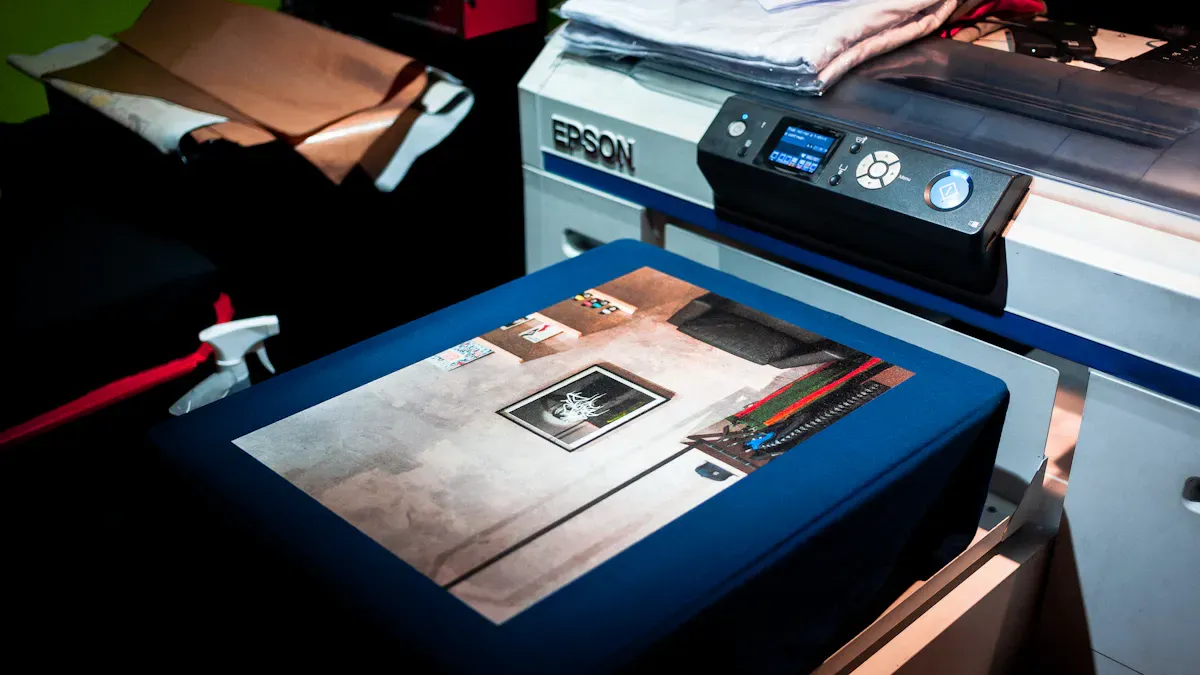
Image Source: pexels
You can use digital printing to make your textile designs stand out. Skyinktex® disperse inks from TIANKUN CHEM help you get bright colors and sharp images on polyester fabrics. These inks work well for dyeing polyester fabrics because they spread evenly and stick to the fibers. You will see that your prints stay bold after many washes. The synthesis of these inks uses advanced methods to keep the colors strong and clear.
Skyinktex® disperse inks offer many features that make your dyeing projects easier. You can use them with different digital printers. The inks do not clog the machines, so you save time and money. You can print sportswear, banners, and fashion fabrics with these dyes. The synthesis of these inks follows strict rules to protect the environment. You get eco-friendly solutions that meet global standards.
Feature | Description |
|---|---|
High Color Strength | Prints look bright and bold on fabrics. |
Excellent Fastness | Designs stay clear after washing and sunlight. |
Wide Compatibility | Works with many digital printers without clogging. |
Versatile Applications | Used for sportswear, banners, and fashion fabrics. |
Eco-Friendly Solutions | Safe for the environment and certified by OEKO-TEX. |
Trusted Support | Expert advice for your printing projects. |
You can use ink-jet printing to apply disperse dyes to polyester fabrics. The process starts with fabric pretreatment. You clean and prepare the fabric so the dyes stick well. You load the fabric into the printer. The printer sprays the dyes onto the fabric in the pattern you want. The synthesis of the dyes makes sure the colors stay bright and do not fade.
After printing, you use heat to fix the dyes. Steaming or thermofixation helps the dyes bond with the fibers. You wash the fabric to remove extra dyes. The synthesis of the dyes makes washing easy and keeps the colors strong. You dry the fabric and check the quality. You can change designs quickly with digital printing. You save water and energy because the process uses less than traditional dyeing.
Benefit | Description |
|---|---|
Water Consumption Reduction | Uses less water than traditional dyeing methods. |
Energy Efficiency | Needs less energy for curing and fixing dyes. |
Adaptability to Fashion Trends | Lets you change designs and colors fast. |
Customization Options | Makes it easy to test and print custom designs for brands. |
Tip: You can print small batches or large orders with digital printing. This helps you meet customer needs and keep up with trends.
You get many benefits when you use disperse dyes for dyeing polyester fabrics. The synthesis of these dyes makes them stick well to polyester. Your prints stay bright and bold after many washes. You can use these dyes for sportswear, banners, and fashion items. The dyeing process is fast and efficient. You save water and energy, so your factory runs better.
You can change designs quickly. You do not need to wait for new screens or tools. The synthesis of the dyes makes them safe for workers and the environment. You get support from TIANKUN CHEM if you need help with your printing projects.
Note: Digital printing with disperse dyes gives you sharp images, strong colors, and lasting quality on polyester fabrics. You can trust the synthesis and dyeing process to help your business grow.
You have to check if your disperse dyes work well in textile printing. Testing dye performance helps you see if your colors stay bright and strong. There are different ways to measure color fastness, dye uptake, and shade depth. You also need to fix problems that can happen during synthesis and dyeing.
You want your colors to last a long time. Color fastness testing shows if your dyes fade or stain. There are many tests for color fastness. Each test uses a set way to see how dyes react to light, weather, and sweat. You compare your results to the blue wool standard. This lets you know if your dyes meet what the industry wants.
Test Method | Description |
|---|---|
Color Fastness to light | Put the fabric in sunlight and check it with the blue wool standard. |
Color Fastness to artificial light | Use fake sunlight and check it with the blue wool standard. |
Color Fastness to weather | Leave the fabric outside and check it with the blue wool standard. |
Color Fastness to human-made weather | Use a xenon arc and spray, then check with the blue wool standard. |
Composite Color Fastness to light and perspiration | Test sweat-treated fabric with light to see how it reacts. |
You should test color fastness at every step of synthesis. This helps you keep your dyes strong and good. You can trust your results if you use the right tests.
You want your fabrics to have deep and rich colors. Dye uptake and shade depth show how much dye your fabric takes in. You can use the K/S value to check color strength. Higher K/S values mean more dye and stronger color. You can also use the color difference index (CDI) to see changes in color, brightness, and how colors look in different lights.
K/S values go up when dyeing takes longer, showing more dye is used.
K/S values get higher with more dye, but stop rising when dye clumps.
CDI gives you one number to track color changes in mixed dyes.
These measurements help you control how you make and use disperse dyes.
You can use these tools to make sure your dyes give you the color you want. You can change your process to get the best results.
You might have problems when dyeing. Color stains can happen if oils do not mix well or if dyes stick together. You can fix this by using a leveling agent instead of a degreasing-dyeing mix. This helps dyes spread out and stops stains.
Watch dye uptake and pressure to find clumping or clogging.
Change your process for different oils and fiber mixes to stop redeposit.
Use the right helpers to make dyes spread and work better.
Tip: Always look at your dye bath for clumps or uneven color. Fixing problems fast keeps your dyes strong and your fabrics looking nice.
You can solve most problems by watching your steps and testing dye performance often. This helps you keep your disperse dyes strong and your prints bright.
You may wonder how using the right disperse dyes can change your business. Let’s look at a real story from Morocco. A well-known dye trader faced many problems. The trader had to work with many suppliers. This made it hard to manage orders and keep track of quality. The trader also waited a long time for answers to questions. Slow replies made it tough to make quick decisions. The biggest worry was about the quality of dyes. The trader needed dyes that always worked well for customers.
TIANKUN CHEM stepped in to help. You can see the main points in the table below:
Challenge | Solution from TIANKUN CHEM | Result |
|---|---|---|
Many dye suppliers | One reliable source for dye | Easier management |
Slow response | Fast answers to dye questions | Quicker decisions |
Quality concerns | High-quality dye every time | Happy end customers |
You can see how one change made a big difference. The trader switched to TIANKUN CHEM for disperse dyes. This meant the trader only needed one supplier. You can imagine how much easier it became to manage orders and keep records. The trader also got fast answers to every question. This helped the trader make decisions quickly and serve customers better. Most important, the trader received high-quality dyes every time. The end customers noticed the bright colors and strong prints. They felt happy with the results.
You want your business to grow. You need dyes that give you bright, lasting colors. You also need a supplier who answers your questions fast. TIANKUN CHEM gives you both. When you use their disperse dyes, you get strong colors that do not fade. You can trust the quality for every order. You also save time because you do not have to wait for answers.
Many customers say that TIANKUN CHEM helps them solve problems. You can focus on your work instead of worrying about dye quality. You know your customers will get the best results. The Moroccan trader saw more happy customers and fewer complaints. You can expect the same when you choose the right dyes and supplier.
Tip: If you want to make your work easier and your customers happier, choose a supplier who cares about quality and service. TIANKUN CHEM shows how the right partner can help you succeed with disperse dyes.
You want your colors to look bright and last long on fabric. To get the best results with disperse dyes, you should follow some important steps during the dyeing process:
Pretreat the fabric with a padding recipe that uses thickeners. This step helps the color spread evenly and increases the color range.
Wash the fabric after printing. This step removes extra dyes and keeps your prints clean and sharp.
Pick the right fixation method. High-temperature steaming or hot-roller fixation works well for locking in color.
Avoid using glycols in your inks. Glycols can lower color yield and slow down drying.
Make sure your ink dispersions stay stable. Stable dispersions prevent nozzle clogging and keep the dyeing process smooth.
Use advanced direct disperse inks. These inks help you get vivid colors and better runnability.
Tip: Always test a small sample before starting a big dyeing job. This helps you spot problems early and save time.
You may face some challenges when working with disperse dyes. Knowing what to watch for helps you avoid mistakes in the dyeing process:
Do not skip fabric cleaning. Dirt and oils can block dyes from entering the fibers.
Watch the temperature closely. Too much heat can damage the fabric, while too little can cause weak colors.
Keep the pH level in the right range. Wrong pH can lead to uneven dyeing or poor color fastness.
Do not overload the dye bath. Too much fabric or dye can cause patchy results.
Check for stable dispersions. Unstable dispersions can clog equipment and waste dyes.
Use the right after-treatment. Washing and softening after dyeing help remove extra dyes and improve fabric feel.
Note: Regularly check your equipment for buildup or clogs. Clean tools help you get better results with every dyeing process.
Different fabrics need different steps in the dyeing process. You must adjust your methods to get the best results with disperse dyes and other dyes. The table below shows how you can change your dyeing process for each fabric type:
Fabric Type | Dye Type(s) Used | Dyeing Procedure Highlights for Disperse Dyes and Adjustments |
|---|---|---|
100% Polyester | Disperse dyes only | Use high temperature and high pressure at 130°C. Try carrier dyeing at 100°C or the Thermosol process at 200–220°C. Finish with reduction clearing for better fastness. |
Polyester/Cotton | Disperse (polyester), Reactive/Vat (cotton) | Dye polyester first at 130°C, then cotton. For one-bath, adjust pH and temperature in steps for both fibers. |
Polyester/Viscose | Disperse (polyester), Reactive/Direct (viscose) | Dye polyester at 130°C, then viscose at 60°C. For one-bath, control dye leveling for lighter shades. |
Wool/Polyester Blend | Disperse (polyester), Acid (wool) | Dye polyester first at 130°C, then wool at 100°C. For one-bath, keep pH around 5 and use a temperature gradient. |
You can see that each fabric type needs a special dyeing process. Polyester needs high heat and pressure for disperse dyes. Blends need you to change the order of dyeing and adjust pH and temperature. Always follow the right steps for each fabric to get strong, lasting colors.
Tip: Keep a record of your dyeing process for each fabric. This helps you repeat good results and fix problems faster.
You can make disperse dyes for textile printing by following simple steps. First, use heat to help dyes go into fibers. You can use dry heat or steam. Next, mix dyes with thickeners, surfactants, and water retaining agents. Then, fix the dye with steam at 212°F (100°C). After that, wash off the thickener.
TIANKUN CHEM disperse dyes are reliable and safe for the environment. You get certifications like Oeko-Tex® and GOTS. These show the textiles are safe and eco-friendly.
Practice | Benefit |
|---|---|
Cold Pad-Batch Dyeing | |
Digital Printing | Reduces waste and improves precision |
Always focus on safety and quality. Check TIANKUN CHEM’s products for expert help and solutions. You can contact their team for advice and good service.
You use disperse dyes mainly for coloring polyester fabrics. These dyes give you bright, long-lasting colors. You can also use them for digital printing on synthetic fibers.
You should keep disperse dyes in sealed containers. Store them in a cool, dry place away from sunlight and moisture. This helps the dyes last longer and keeps them safe to use.
Disperse dyes work best on polyester and other synthetic fibers. They do not bond well with cotton. For cotton, you should use reactive or direct dyes instead.
Temperature helps disperse dyes enter the fibers. High heat opens the polyester fibers, letting the dye go in. If you use the right temperature, you get brighter and stronger colors.
Yes! TIANKUN CHEM disperse dyes meet strict environmental standards. You can use them with confidence because they do not contain harmful chemicals. They help you follow green practices in your factory.
Check if you cleaned the fabric well before dyeing. Make sure you used the right temperature and pH. Stir the dye bath evenly. You can also use leveling agents to help the color spread better.
You can test color fastness by exposing dyed fabric to light, washing, or rubbing. Compare the results to a standard chart. This helps you see if the color will last during use.