Dyestuff industry experts
ITMA AISA 2026



- Home
- About
- Online Q & A
- Products
- Applications
- Solution
- Service
- Our Brand
- Info
- Contact
Views: 5 Author: Site Editor Publish Time: 2026-08-13 Origin: Site


Vat dyes give strong, lasting colors to cotton and other cellulosic fibers. These dyes are special because they do not dissolve in water. You need a reducing agent to use them. Vat dyes make deep colors like indigo and navy blue. The colors stay bright after washing and sunlight. Here are the main chemical properties that make vat dyes important in textiles:
Property | Description |
|---|---|
Solubility | Does not dissolve in water |
Fastness | Stays bright after washing and sunlight |
Application | Needs a reducing agent |
Color Range | Deep colors like indigo and navy blue |
When you pick TIANKUN CHEM for your dyes, you get good results and bright colors every time.
Vat dyes give strong and long-lasting colors to cotton and other cellulosic fibers. This makes them great for tough fabrics. These dyes need a reducing agent to dissolve. This helps them go into fibers and make bright, deep colors. Vat dyes are very good at keeping their color. They do not fade much from washing or sunlight. This helps clothes stay bright for a long time. Using vat dyes can also help the environment. New ways of using them make less chemical waste and help the planet. To get the best results, follow each step in the vat dyeing process. This includes pre-treatment, reduction, and oxidation.
Vat dyes are special colorants for cotton and other cellulosic fibers. These dyes will not dissolve in water. You must change them so they can mix with water. Vat dyes become soluble when you use a reducing agent and an alkaline solution. This lets the dye go into the fibers. After dyeing, you put the fabric in air or use an oxidizing agent. The dye goes back to its original form and stays inside the fibers. This method gives strong colors that last through washing and sunlight.
Skythrene® Vat Dyes from TIANKUN CHEM show the best features of vat dyes. You get bright colors and great fastness on cellulosic fibers. These dyes help you make deep shades and even results. You can trust Skythrene® Vat Dyes for high-quality textile production.
It is important to know how vat dyes work to get good results. The process has several steps:
Vat dyes start in their insoluble form.
You add a reducing agent like sodium hydrosulfite and an alkali such as sodium hydroxide. This changes the dye into a soluble leuco form.
You put the fabric in the dye bath. The leuco dye goes into the fibers and gives a pale color.
You expose the fabric to air or an oxidizing agent. The dye goes back to its insoluble form and stays inside the fibers.
You rinse the fabric to remove extra dye and impurities.
Tip: Always use the correct reducing agent and keep the dye bath at the right pH. This helps the dye go into the fibers well.
Vat dyes are special because of their main properties. You can see how they compare to other dye types in the table below:
Aspect | Mordant Dyes | Vat Dyes |
|---|---|---|
Solubility | Water-soluble | Insoluble until reduced |
Bonding | Metal coordination | Reduction–oxidation |
Chemicals Used | Aluminum, chromium | Sodium hydrosulfite, caustic soda |
Wash Fastness | Moderate–Good | Excellent |
Light Fastness | Good | Excellent |
Chemical Resistance | Low–Moderate | Very High |
Chlorine Fastness | Poor | High |
You get many benefits when you use vat dyes:
Vat dyes give you strong colorfastness and durability.
You can use them for tough jobs like denim jeans, workwear, and cotton clothes.
These dyes resist fading and harsh treatments.
Vat dyes work best on natural fibers like cotton, viscose, and linen.
You can count on vat dyes for industrial textiles and products that need strong colors.
Skythrene® Vat Dyes from TIANKUN CHEM have these important properties. You get steady results and bright shades every time you use them. These dyes help you reach high standards in textile manufacturing.
Image Source: unsplash
It is important to know how vat dyes act in water. Vat dyes will not dissolve in water. This is a main property. You cannot use them on fabric right away. You must change them first. The process is called vatting. You mix dye powder with water, caustic soda, and a reducing agent. This makes the dye soluble. The soluble dye is called leuco dye. Leuco dye can go into cotton and other cellulosic fibers.
Here is how the reduction process works in textile dyeing:
Step | Description |
|---|---|
Vatting | Mix insoluble vat dye powder with water, caustic soda, and a reducing agent to form a soluble leuco dye. |
Dyeing | Immerse wet cotton fabric in the reduced, alkaline dye bath. The soluble dye penetrates the fiber. |
Oxidation | Expose fabric to air or mild chemicals. The leuco dye turns back to its insoluble form and stays inside the fiber. |
Washing | Wash fabric to remove extra chemicals and unfixed dye. |
The dye stays locked inside the fiber. This gives strong colors that last. Vat dyes are great for denim and work clothes. Skythrene® Vat Dyes from TIANKUN CHEM use this method. You get deep, bright colors that stay.
Note: Always follow the steps in vatting. This helps the dye go into the fiber and gives the best results.
Vat dyes are special because they keep color well. You want your fabrics to stay bright after washing and sunlight. Vat dyes do a great job in these areas. You can see how they compare to other dyes in the table below:
Fastness Criterion | Vat Dyes | Reactive Dyes | Direct Dyes |
|---|---|---|---|
Washing Fastness | Excellent (Grade 5/5) | Very Good (Grade 4-5/5) | Poor (Grade 2-3/5) |
Rubbing Fastness | Very Good (Grade 4-5/5) | Good (Grade 3-4/5) | Average (Grade 3/5) |
Light Fastness | Superior (Grade 7-8/8) | Good (Grade 4-6/8) | Poor (Grade 3-4/8) |
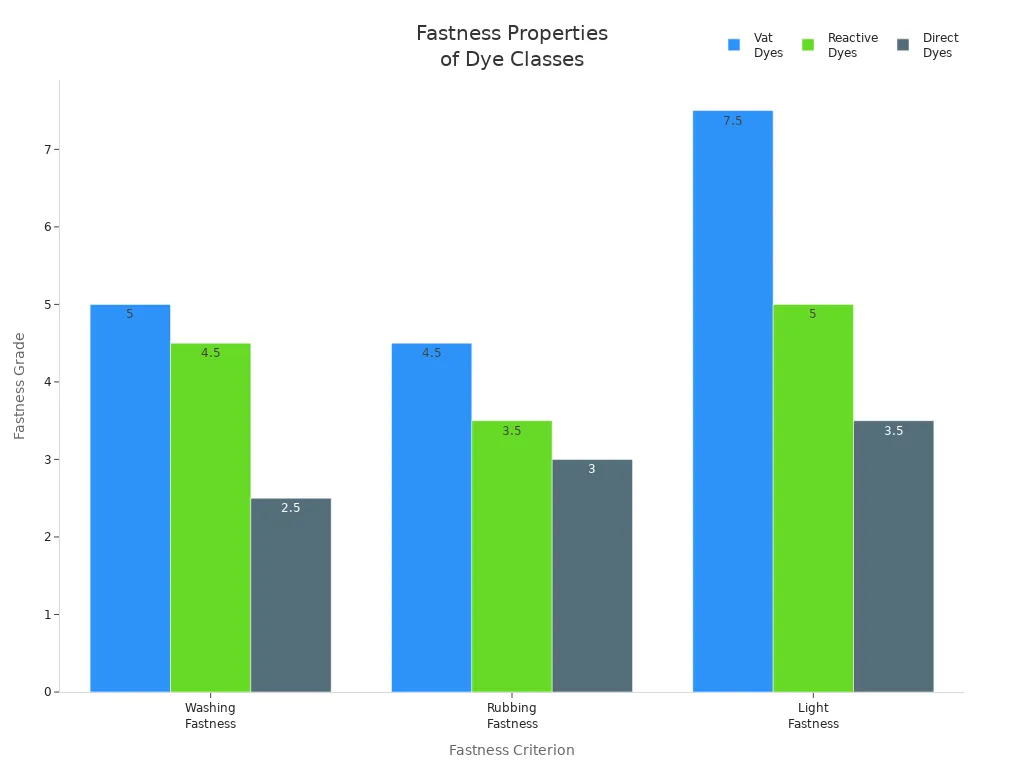
Fabrics resist fading and stay bright. Vat dyes are used for cotton and cellulosic fibers. You see them in denim, uniforms, and work clothes. These dyes help you meet high standards in textiles. Skythrene® Vat Dyes from TIANKUN CHEM have these properties. Your products become strong and reliable.
Tip: Pick vat dyes if you need fabrics that stay bright after washing and sunlight.
Vat dyes have a special molecular structure. This structure gives them their main properties. Vat dyes have at least two carbonyl groups. These groups change to hydroxyl groups in alkaline solutions. This change is important. It makes the dye soluble so it can go into the fiber. When you oxidize the dye, it goes back to its original form and stays inside the fiber.
Vat dyes have at least two carbonyl groups (=C=O).
These groups change to hydroxyl groups (-OH) in alkaline solutions.
The change makes the dye soluble and lets it go into cellulosic fibers.
Oxidation makes the dye insoluble again and locks it inside the fiber.
This process gives vat dyes high fastness to washing and light.
Your fabrics keep their color and resist damage. The chemical properties of vat dyes make them good for printing and dyeing cotton and polyester-cotton blends. Skythrene® Vat Dyes from TIANKUN CHEM use this structure. You get bright colors that last a long time.
Remember: The molecular structure of vat dyes is why they work so well in textiles.
You must follow each step to get good results with vat dyes. The vat dyeing process for cellulosic fibers has a few main steps:
Pre-treatment: First, you treat the fabric with a reducing agent. This step makes the fabric ready for dyeing.
Vat dye application: Next, you add the vat dye to the fabric. The dye is not soluble at this point.
Reduction: The reducing agent changes the vat dye so it can dissolve. This lets the dye go into the fiber.
Oxidation: Then, you let the fabric touch air or use a chemical. The dye turns back to its insoluble form and stays inside the fiber.
Tip: Every step in vat dyeing matters. If you skip a step, you might get uneven color or weak fastness.
Reducing agents are very important when using vat dyes. They help make the dye soluble so it can enter the fiber. Some common reducing agents are:
Sodium hydrosulfite (sodium dithionite)
Sodium hydrosulfite in an alkali solution
Sodium hydrosulfite with formaldehyde (Rongalite C)
Sodium borohydride with sodium formaldehyde sulfoxylate and sodium nickel cyanide
Thiourea dioxide
Endiols like hydroxyacetone with ultrasonic mixing
The kind and amount of reducing agent can change the color and fastness. You also need to watch the temperature, liquor ratio, and salt amount. These things help you get bright colors and show the good and bad sides of vat dyes.
Step | Description |
|---|---|
1 | The dye is made soluble by a reducing agent. |
2 | The soluble dye goes into the fiber. |
3 | The dye turns insoluble again and stays in the fiber. |
You want your dyed fabrics to be bright and last a long time. TIANKUN CHEM helps you reach this goal. The company gives you advice so you use vat dyes the right way. You get help with controlling oxidation, managing soaping, and using steady dyes. This support helps you avoid problems and get the best from vat dyes.
Aspect | Importance |
|---|---|
Consistent Dyes | You get results you can count on, making dyeing easier. |
Oxidation Control | You get even color and stable shades by controlling oxidation. |
Soaping Process | You remove extra dye and make the color better, which helps fastness and brightness. |
Note: When you work with TIANKUN CHEM, you get expert help and reliable dyes. This support helps you get high-quality results every time.
When you choose vat dyes for your textile projects, you get many important benefits. These dyes help you create fabrics that last and look great. Here are some reasons why vat dyes stand out in the textile industry:
Vat dyes give you outstanding light fastness. Your fabrics keep their color even after long exposure to sunlight or frequent washing.
You see rich and vibrant colors. Vat dyes go deep into the fibers, so the colors stay bright after many washes.
The dyeing process with vat dyes has become more environmentally friendly. New methods help reduce chemical waste and support sustainable practices.
Vat dyes offer excellent durability. The dyes bond strongly to cellulose fibers, so your garments keep their color for a long time.
You can use vat dyes on many materials, such as cotton, linen, and denim. This makes them a top choice for different textile products.
Vat dyes resist high temperatures. You can use them for industrial textiles that need to handle heat.
Over time, vat dyes can save you money. The colors last longer, so you do not need to re-dye fabrics as often.
Skythrene® Vat Dyes from TIANKUN CHEM show all these strengths. You get reliable results, bright shades, and support for sustainable textile production.
Tip: If you want fabrics that stay colorful and strong, vat dyes are a smart choice.
While vat dyes offer many advantages, you should also know about some general limitations:
Vat dyes may have a limited color range compared to other dyes. You might not find every shade you want.
The dyeing process for vat dyes can be more complex. You need to follow each step carefully to get the best results.
Vat dyes sometimes cost more at the start. The process and chemicals can add to the price.
You need special handling and equipment for vat dyes. This can make the process harder for small-scale operations.
Knowing both the strengths and limits of vat dyes helps you make the best choice for your textile needs. When you use high-quality dyes like Skythrene® Vat Dyes, you get the most value and performance for your fabrics.
You now know vat dyes give strong color and last a long time. They also keep their color after washing. When you pick dyes, remember these things:
Dye particles should be small for even color.
The color should not fade after washing.
Very fine powders help the dye go on smoothly.
The right chemical steps are important.
Good vat dyes from TIANKUN CHEM keep your fabrics bright and tough. Always choose dyes that fit your fabric and process for the best results.
You use vat dyes to color cotton, linen, and other cellulosic fibers. These dyes help you create strong, bright fabrics that resist fading and washing.
You mix the dye with a reducing agent and alkali. This makes the dye soluble. You dip the fabric in the dye bath, then expose it to air to lock in the color.
You can choose vat dyes that support eco-friendly practices. Many modern vat dyes, like Skythrene® Vat Dyes from TIANKUN CHEM, help you reduce chemical waste and follow sustainable methods.
Vat dyes bond deeply with fibers. You get colors that stay bright after many washes and sunlight. The special dyeing process locks the color inside the fabric.
You can use vat dyes for both large and small textile projects. These dyes work well in factories and home dyeing setups. You just need to follow the correct steps.