Dyestuff industry experts
ITMA AISA 2026



- Home
- About
- Online Q & A
- Products
- Applications
- Solution
- Service
- Our Brand
- Info
- Contact
Views: 7 Author: Site Editor Publish Time: 2026-03-02 Origin: Site


Because the same color will produce different effects under different light sources, different dyes, and different base colors, it is essential to adhere to the customer's specified light source requirements when printing and dyeing. Before starting a project, it's crucial to clarify the customer's required light source. If the customer's order doesn't specify a standard light source, it's vital to communicate with them promptly to avoid unnecessary costs.
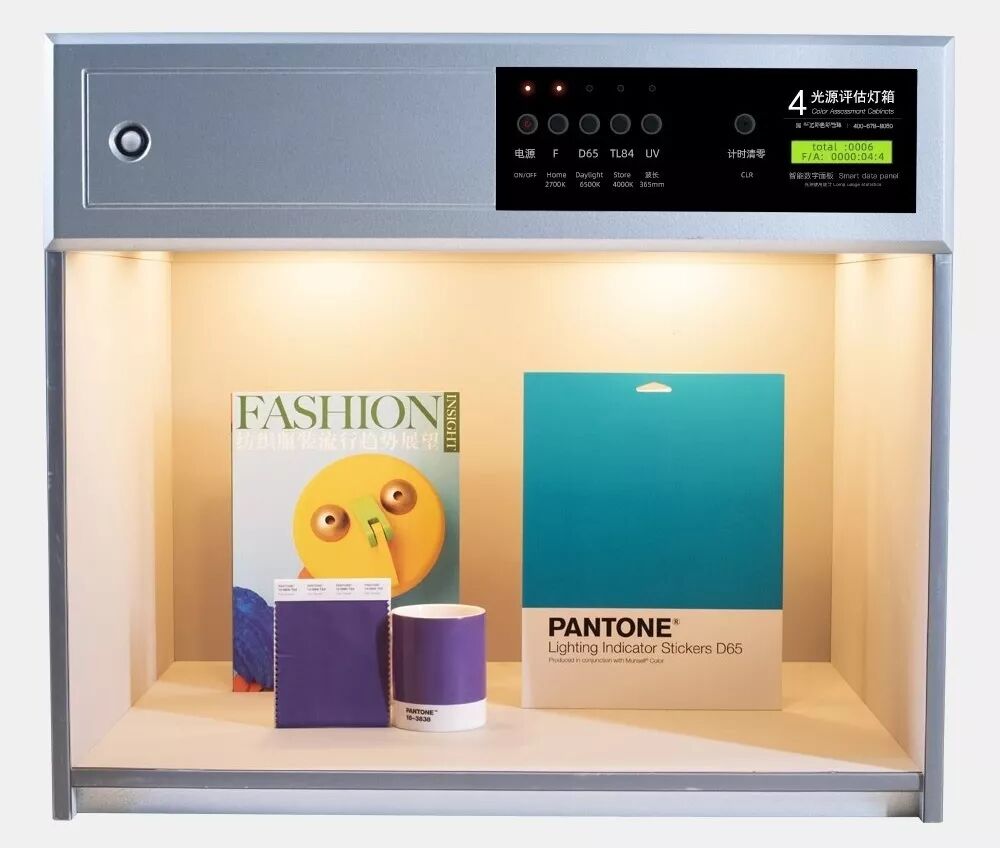
Light sources are actually divided into two types: natural light sources and artificial light sources. The former mainly refers to sunlight, while the latter includes various electric light sources such as incandescent lamps, halogen lamps, fluorescent lamps, and xenon lamps. In daily life, people are accustomed to identifying colors under natural light. However, due to the influence of factors such as time, climate, season, and latitude, the color of natural light is not stable. Therefore, modern industry tends to use artificial light sources to achieve accurate color matching.
Related Terminology: Color temperature (Kelvin) is a measure of the color of a light source. Color temperature has important applications in photography, videography, and publishing. The color temperature of a light source is determined by comparing its color with that of a theoretically hot blackbody radiator. The Kelvin temperature at which the color of a thermal blackbody radiator matches that of a light source is the color temperature of that light source, and it is directly related to Planck's law of blackbody radiation.
2. Three Stages of Standard Light Source Development:
To define artificial light sources used for evaluating color appearance, the CIE (International Commission on Illumination) has successively specified a series of standard illuminants and standard light sources. Its development has roughly gone through three stages:
The CIE specified three standard illuminants, A, B, and C, and recommended corresponding standard light sources;
(2)1967
To compensate for the deficiencies of standard illuminants B and C in the ultraviolet region, the D series of standard illuminants was specified, including D50, D65, D75, etc., spanning the ultraviolet, visible, and infrared regions of natural light;
3. After 1970, with the increasing popularity and widespread commercial application of fluorescent lamps, the CIE specified the F series of fluorescent light sources, of which F1-F6 are ordinary fluorescent lamps, F7-F9 are high color rendering fluorescent lamps, and F10-F12 are tri-color fluorescent lamps.