Dyestuff industry experts
ITMA AISA 2026



- Home
- About
- Online Q & A
- Products
- Applications
- Solution
- Service
- Our Brand
- Info
- Contact
Views: 31 Author: Site Editor Publish Time: 2026-09-01 Origin: Site


Think about your favorite cotton t-shirt. The color stays bright through many washes. Now picture a cheap printed design that fades after just a few cleanings. What makes the difference?
The answer lies in reactive dyes. These special colorants form a permanent chemical bond with fabric fibers. Unlike surface coatings, this bond becomes part of the cloth itself. The global market shows their importance, growing steadily each year.
Year | Market Size (USD) | CAGR |
|---|---|---|
2025 | 6.37 billion | 9.4% |
2034 | 14.25 billion | 9.4% |
This article explains how these dyes work chemically, why they excel on cotton, and what makes them a smart choice for bright, lasting color.
Reactive dyes make a lasting chemical bond with cotton fibers, so colors stay bright through many washes.
The dyeing process uses salt and alkali to help the dye bond with the fabric at the right temperature.
Reactive dyes make colors brighter and stay in fabric better after washing than regular dyes do.
You can use cold-water reactive dyes at home for tie-dye and other crafts without needing heat.
Picking reactive dyes that bond well with fabric cuts down on water pollution and helps make textile production kinder to the environment.
Reactive dyes, also called fiber reactive dyes, are a special type of synthetic colorant. Regular dyes just sit on top of the fabric, but these molecules form a strong chemical bond with the fiber itself. This bond is not a physical coating. It is a true chemical reaction that permanently changes both the dye and the fiber. The result is color that becomes part of the cloth's structure, surviving repeated washing and exposure to sunlight.
The secret lies in the reactive group, often called the "soul" of the dye molecule. This functional group can form covalent bonds with specific sites on the fiber. For cellulosic fibers, the reactive group—such as monochlorotriazine—attacks the hydroxyl groups (-OH) under alkaline conditions. The chlorine atom on the triazine ring gets replaced by the cellulosic hydroxyl group, creating a stable ether bond.
Different reactive groups offer different reactivity levels. Vinylsulphone dyes are moderately reactive, dyeing at 60°C and pH 11.5. Monochlorotriazine dyes need higher temperatures around 80°C and pH 10.5. Bi-functional dyes contain more than one reactive group, allowing multiple bonding mechanisms with the fiber. This variety gives manufacturers flexibility in choosing the right dye for their process.
A competing reaction also occurs during dyeing. Water molecules can react with the chlorine atom, forming hydrolyzed dye. This explains why fixation rates never reach 100%. Some dye always gets lost to this side reaction.
Cellulosic fibers—cotton, linen, and rayon—contain abundant hydroxyl groups along their polymer chains. These -OH groups serve as perfect reaction sites for fiber reactive dyes. The process follows a clear sequence:
You add an alkali, such as soda ash or caustic soda, to the dye bath.
The alkaline condition activates the fiber's hydroxyl groups.
The activated hydroxyl groups react with the dye's reactive groups.
This reaction forms a permanent covalent bond.
Under alkaline conditions (pH 10.5–11.5), the reactive group chemically bonds with cellulose's -OH groups. The reaction produces permanent color with excellent wash durability. This chemical bonding makes the dye an integral part of the fiber, resulting in exceptionally high colorfastness and vibrant, long-lasting colors on cotton, linen, and rayon.
The molecular structure of these dyes also affects their efficiency. More flexible reactive groups lead to more effective reactions. However, complex molecular structures may hinder diffusion into fibers, reducing bonding efficiency. Manufacturers must balance reactivity with penetration to achieve optimal results.
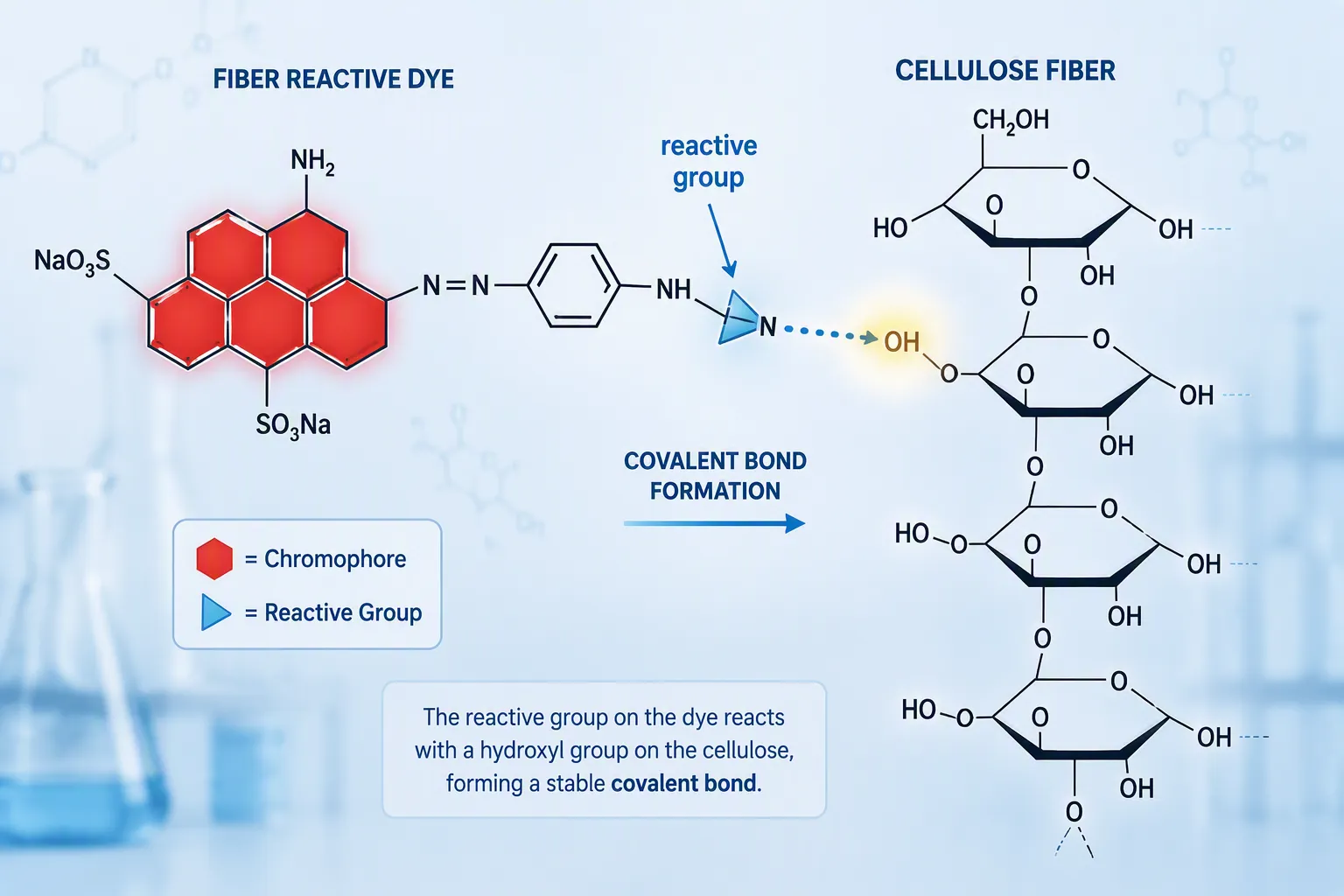
Every fiber reactive dye molecule has two key parts: a chromophore that gives color and a reactive group that makes the bond. The chromophore soaks up certain light waves, creating the bright color you see. The reactive group does the main job. It works like a chemical hook, ready to grab onto the fiber.
Cellulose fibers like cotton have many hydroxyl groups (-OH) along their polymer chains. These groups stick out from the fiber's surface and inside, waiting for a partner to react. When you bring fiber reactive dyes near cellulose under the right conditions, the reactive group attacks these hydroxyl spots.
Different reactive groups exist, each with its own chemical makeup and how fast it reacts. The table below shows the common types:
Reactive Group | Chemical Nature |
|---|---|
Monochlorotriazine | Haloheterocycle |
Monofluorochlorotriazine | Haloheterocycle |
Dichlorotriazine | Haloheterocycle |
Difluorochloropyrimidine | Haloheterocycle |
Dichloroquinoxaline | Haloheterocycle |
Trichloropyrimidine | Haloheterocycle |
Vinyl sulfone | Activated double bond |
Vinyl amide | Activated double bond |
Store-bought products use these groups in different mixes. For example, Procion MX dyes use dichlorotriazine, while Procion H dyes use monochlorotriazine. Dylon products contain chlorodifluoropyrimidine. Each type has its own benefits in how fast it reacts and at what temperature you use it.
The trip from dissolved dye to lasting color goes through three clear steps. Knowing each phase helps you see why the process needs careful control.
Migration: Dye molecules move from the dye bath to the fiber surface. Temperature, salt (electrolyte), and wetting agents help this move. The salt lowers the push between the negatively charged dye and the fiber surface, letting them get closer.
Diffusion: The dye goes from the fiber surface into its inside. Heat, stirring, and enough time push this process. Without good diffusion, the dye stays on the surface and washes off easily.
Fixation: Under alkaline conditions (pH 10.5–11.5), the reactive group makes a covalent bond with the hydroxyl groups of cellulose. This bond, which shares electrons, permanently attaches the dye to the fiber.
The fixation step needs a closer look. When you add an alkali like soda ash to the dye bath, it takes a proton from the hydroxyl groups on cellulose. This activation makes them more reactive and ready to bond. Soda ash gives stable, easy pH control compared to stronger alkalis like NaOH, which can raise hydrolysis risk in long hot processes.
For monochlorotriazine dyes, the process is nucleophilic substitution. The chlorine atom on the triazine ring gets pushed out by the cellulosic hydroxyl group, forming a stable ether bond (Cell-O-R). But the second chlorine atom reacts more easily with water, making hydrolyzed dye. This side reaction explains why fixation rates never hit 100%.
According to research, the usual dye fixation efficiency for reactive dyes on cotton is 50-80%. That means 20-50% of the dye you put on does not fix to the fabric. Instead, it washes away as waste, causing both dye loss and environmental pollution.
Vinylsulfonyl dyes, like Remazol, follow a different route. The dye attaches to an ethylsulfonyl group. Under alkaline conditions, this group adds directly to cellulose hydroxyl groups, making a covalent bond without pushing out a halogen atom.
The best pH for cotton reactive exhaust dyeing is about 10.5–11.0. At low pH, dye fixation stays weak. At very high pH, hydrolysis and fiber damage increase fast. You must balance these factors to get the most color while keeping the fabric safe.
Knowing this chemistry helps you see why fiber reactive dyes make such durable, bright colors. The covalent bond makes the dye part of the fiber itself, not just a coating on the surface. That permanent link gives the wash-fastness and vibrancy you expect from high-quality textiles.
Now you know the chemistry behind fiber reactive dyes. Let's go through the reactive dyeing process step by step. To get good, steady results, you need to control several things carefully. You must manage temperature, time, chemical amounts, and the liquor ratio. Each factor affects the final color quality and how well the dyeing works.
The reactive dyeing process follows a clear order. First, you prepare the bath. Fill your machine with the right amount of water based on the liquor ratio. A low ratio like 1:5 in jet machines keeps chemicals more concentrated and saves water. A high ratio uses more water and energy but does not improve fixation.
Next, you dissolve the dye fully in water. If you don't dissolve it well, the dyeing will be specky or uneven. Always add the dye slowly to warm water while stirring. After dissolving, put the wet, well-prepared fabric into the bath.
Then comes the salt addition. For fiber reactive dyes, you use 60-100 g/L of salt for medium shades. Add the salt in 2-3 parts, waiting 10-20 minutes between each. For heavy shades, you may need up to 120 g/L with bifunctional reactive dyes. The salt helps push the dye molecules onto the fiber by lowering the electrical repulsion.
After adding salt, you raise the temperature. The temperature depends on the dye type. Cold-brand dyes (dichlorotriazine types) work at 30-40°C. Warm-brand dyes (vinyl sulfone types) work at 40-60°C. Hot-brand dyes (monochlorotriazine types) need 60-80°C for good fixation. You raise the temperature to the fixation point over 30-40 minutes.
Now comes the alkali dosing. Fixation of fiber reactive dyes depends on the right pH. You slowly add soda ash or caustic soda over 20-30 minutes, starting at 45-55 minutes into the process. This raises the pH to 10.5-11.5. The alkali wakes up the hydroxyl groups on the cellulose fibers. This lets the reactive groups on the dye molecules form covalent bonds. Too little alkali gives poor fixation. Too much alkali causes hydrolysis of the dye, which lowers color yield.
The bath stays at fixation temperature for 75-90 minutes. After fixation, you drain the bath and rinse the fabric. Then you neutralize it. You add acid and run the bath for 20 minutes at 40°C to remove leftover alkali from the fibers.
Not all reactive dyes need heat to fix. Cold-water fiber reactive dyes work at room temperature. They use chemical fixation with soda ash without needing heat. These dyes are great for tie-dye, immersion dyeing, ice dyeing, batik, and fabric painting at home. They form the same permanent covalent bond with cellulosic fibers like cotton, rayon, hemp, bamboo, and Tencel.
High-temperature reactive dyes need 75-95°C for good fixation. These dyes work well in industrial settings like jet dyeing machines and continuous processes. They give very high exhaustion and fixation rates with excellent leveling. They handle polyester-cotton blends and other cellulosic blends well.
The table below compares these two methods.
Feature | High-Temperature Dyeing | Cold-Water Dyeing |
|---|---|---|
Application Temperature | 75-95°C | Room temperature |
Typical Fibers | Polyester-cotton blends, cellulosic blends | Cotton, rayon, hemp, bamboo, Tencel |
Fixation Method | High-temperature exhaustion | Chemical fixation with soda ash |
Fixation Quality | Very high exhaustion and fixation | Permanent covalent bond |
Leveling Properties | Excellent | Good with proper technique |
Best Applications | Jet dyeing, continuous processes | Tie-dye, immersion, ice dyeing, batik |
Energy Requirement | High (heating needed) | None (no heat needed) |
The energy savings from cold methods are big. Normal exhaust dyeing uses a lot of energy and water. Cold pad batch methods work at 25°C and cut energy and water use a lot. Studies show that using cold pad batch processes reduces both thermal and electrical energy.
You can also make your process better by picking the right salt and alkali. Some manufacturers use organic alternatives like TNA at 50 g/L. This replaces regular salt and alkali while giving almost the same color strength. Such new ideas lower the environmental impact of the reactive dyeing process without losing quality.
Paying attention to each step helps you get the best color yield and wash-fastness from your dyes.
The covalent bond between fiber reactive dyes and cellulose creates color that survives wash after wash. This chemical connection differs fundamentally from weaker dye types. Direct dyes rely on physical adsorption—Van der Waals and hydrogen bonds—which wash out gradually. Reactive dyes form a permanent chemical link that becomes part of the fiber itself.
Dye Type | Bond Type | Wash Fastness |
|---|---|---|
Reactive Dyes | Covalent bonds | High wash fastness |
Direct Dyes | Physical adsorption | Lower wash fastness |
You get richer, deeper colors with reactive dyes. The chromophore structure absorbs light efficiently, producing shades that stay vivid over time. Light fastness ratings for quality reactive dye series reach 5–6 on the ISO 105-B02 scale, notably higher than conventional active dyes at 3–4 levels. This durability makes them ideal for outdoor textiles like curtains and sunshade cloth.
Products like TIANKUN CHEM's Skyzol® Reactive Dyes deliver excellent color yield and brightness. Their formulation ensures colors remain vivid through repeated laundering and sun exposure. The strong bond supports long-term colorfastness under harsh conditions.
Fiber reactive dyes adapt to many textile processes. You can use them for exhaust dyeing, continuous dyeing, pad-batch, cold-pad-batch, printing, and garment dyeing. This flexibility suits both industrial production and home crafting projects.
Most fiber reactive dyes qualify as low-impact and meet Oeko-Tex Standard 100. This certification means fabrics dyed with them are safe for sensitive skin. As Dharma Trading Co. notes, babies can chew on clothing dyed with these dyes, and chemically sensitive people can wear them without concern.
"Fiber Reactive dyes are the ONLY dyes that this is true of. Natural dyes from plants and insects are not permanent. The chemical mordants used with natural dyes are metallic salts and some are highly toxic."
New generations of low-salt and high-fixation reactive dyes reduce water and chemical loads in textile processing. Cold pad-batch dyeing eliminates the need for heat, salt, or humectants, boosting energy efficiency for eco-friendly cotton production. These innovations lower dye waste and cut water usage in the washing-off process.
Approximately 20% of industrial water pollution comes from fabric dyes and treatments. Choosing fiber reactive dyes with high fixation rates minimizes your environmental footprint. Vat and direct dyes remain considerably more hazardous to people and the planet. By selecting quality reactive dyes, you balance vibrant color with environmental responsibility.
Fiber reactive dyes make a permanent covalent bond with the fiber. This bond makes the color part of the fabric. You get better colorfastness and bright colors. These dyes work perfectly on natural fibers like cotton and linen.
The dyeing process uses water, salt, and chemicals. But the industry is moving toward sustainable practices. Fiber reactive dyes reduce dye waste through covalent bonding. This dye chemistry uses less energy because it needs less washing. The dye also has safe ingredients without harmful chemicals. TIANKUN CHEM develops new reactive dye molecules with brighter colors. These fiber reactive dyes are the future of textile coloring.
The chemistry is complex, but the result is durable, beautiful color. The future balances bright color with care for the environment.
Reactive dyes are colorants that form a permanent chemical bond with fabric fibers. Unlike surface coatings, this covalent bond becomes part of the cloth's structure. You get color that survives repeated washing without fading. This makes them ideal for cotton, linen, and rayon fabrics.
Regular dyes sit on the fabric surface and wash out gradually. Fiber reactive dyes create a chemical link with the fiber itself. This bond shares electrons with the cellulose molecules. You get superior wash-fastness and brighter colors that stay vivid over time.
Fiber reactive dyes work best on natural cellulosic fibers like cotton, linen, and rayon. Synthetic fabrics like polyester lack the hydroxyl groups needed for bonding. You should choose disperse dyes for polyester instead. Each dye type matches specific fiber chemistry for best results.
Modern reactive dyes offer better eco-profiles than older alternatives. High fixation rates mean less dye waste in wastewater. Many products meet Oeko-Tex Standard 100 certification. You reduce environmental impact by choosing quality dyes with excellent exhaustion rates and lower salt requirements.
Temperature depends on the dye type you select. Cold-water reactive dyes fix at room temperature using soda ash. Hot-brand dyes need 60-80°C for proper fixation. You can choose the method that fits your equipment and energy budget.