Dyestuff industry experts
ITMA AISA 2026


- Home
- About
- Online Q & A
- Products
- Applications
- Solution
- Service
- Our Brand
- Info
- Contact
Views: 2 Author: Site Editor Publish Time: 2026-09-10 Origin: Site


Reactive dyes bond with cellulose fibers, making them key for coloring cotton. These dyes give bright colors and strong resistance to washing and light, which is why the textile industry uses them so widely. The global reactive dyes market hits USD 6.37 billion in 2025, says Custom Market Insights.
This article lists the top reactive dyes makers for 2026, with a special focus on identifying a trusted reactive dyes manufacturer. We picked them based on production size, new technology, green efforts, and global presence. Readers learn useful details about possible suppliers and new market trends. Knowing each maker's strengths helps buyers choose wisely, especially when evaluating a reactive dyes manufacturer for long-term partnerships. The textile field keeps changing, asking for better quality and eco-friendly options. This guide helps professionals find reliable partners in the reactive dyes field, ensuring they select a reactive dyes manufacturer that prioritizes quality and sustainability. Quality stays the top priority when picking suppliers for lasting success.
Reactive dyes attach to cotton fibers to make bright colors that last a long time.
Top manufacturers focus on dyes that are safe for the environment and on making them in ways that do not harm nature.
Buyers should look at a manufacturer's quality, new ideas, and how far it reaches around the world.
Digital tools and artificial intelligence help dyeing work better and create less waste.
The market is growing, with a move toward eco-friendly and affordable options.
Choosing the best reactive dyes maker needs a clear way to check them. The textile industry wants partners who give steady quality and meet today's green rules. This part explains what makes top producers stand out from normal suppliers.
New ideas push the reactive dyes market forward. Top makers spend a lot on research to create dyes that stick better, give brighter colors, and last longer. New breakthroughs include two-part reactive dyes that give up to 30% more color than older types. These advanced mixes use less water and energy when dyeing, so they appeal to eco-friendly textile makers.
A wide range of products matters just as much. Leading companies offer reactive dyes in many colors, like yellow, black, red, blue, and orange. They also make special mixes for different ways of dyeing, such as low-salt versions that soak up better and hurt the environment less. The best makers combine big product lines with help services that assist mills in improving their dyeing steps.
The chart below shows how industry experts rate makers:
Scoring Framework | Key Evaluation Parameters |
|---|---|
Company Scoring Matrix | Market share, product innovation, brand recognition |
Market Attractiveness Scoring | Growth potential, competitive dynamics, strategic fit |
Going green has become a key factor when picking a reactive dyes maker. Buyers now look for certifications that prove a company cares about the environment. The OEKO-TEX® STeP certification stands out as a top mark for sustainable factories, covering chemical use, environmental performance, and social responsibility. Other important credentials include ISO 14001 for environmental management, Bluesign for efficient production, and ZDHC compliance for chemical safety.
OEKO-TEX® STeP Certification confirms that factories operate sustainably, covering chemical management, environmental performance, and social responsibility.
Global reach also matters when choosing a supplier. Established makers have factories on several continents, which keeps supply chains steady and gives local technical help. They run their operations from raw materials to finished goods, which improves quality control and cuts delivery times. This full-control approach helps reactive dyes makers respond fast to changing market needs while keeping product quality the same across batches.
The reactive dyes market keeps growing, pushed by demand for green textile solutions. Makers that mix new technology with strong green credentials become the top choice for future partners.
Europe holds a strong position in the global reactive dyes market. Several companies from this region lead the industry through innovation and sustainable practices. The table below shows the European market shares of key reactive dyes manufacturers in 2026.
Company | Market Share (Europe) | Key Insight |
|---|---|---|
Archroma (Swiss) | ~12% | Focuses on sustainability; 5% annual revenue growth |
Huntsman | ~10% | Strong in high-performance textiles; ~$8B revenue |
Kiri Industries | ~8% | Cost-effective production strategy |
Kyung-In | ~7% | Expanding distribution channels in Europe |
Colourtex | ~6% | Developing novel products |
Jay Chemicals | ~6% | Expanding manufacturing capabilities |
Everlight Chemical | ~5% | Niche in specialty dyes; pursuing M&A |
Sumitomo | ~5% | Strategic alliances for distribution |
Bodal Chemical | ~4% | Strategic alliances for distribution |
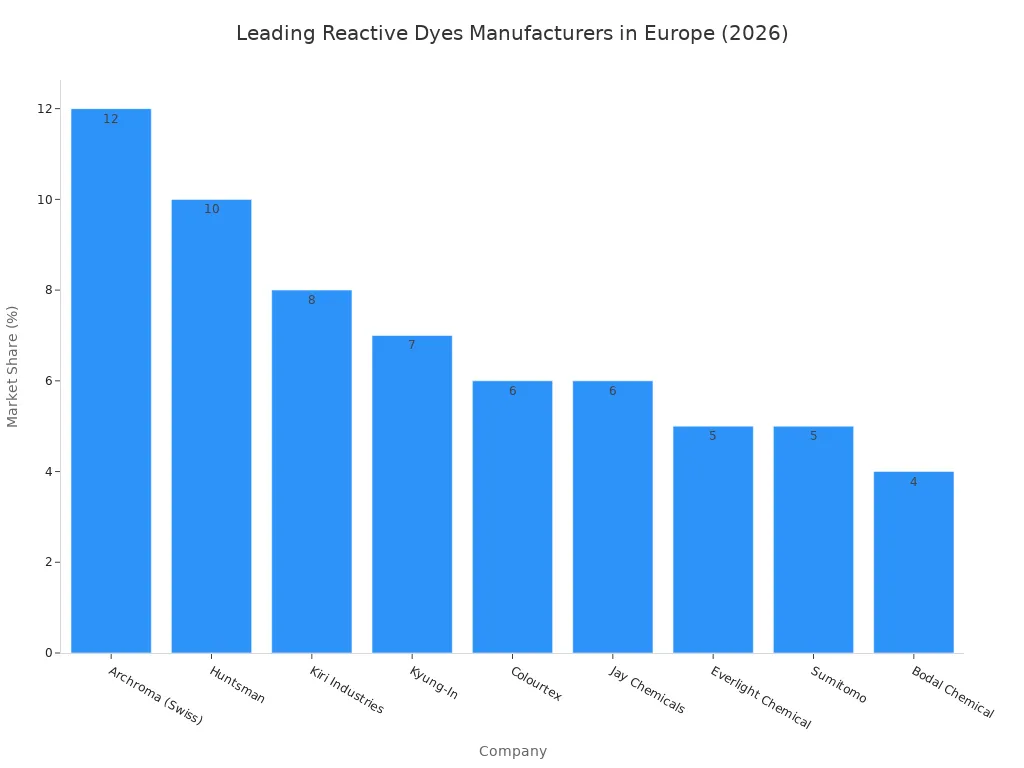
Archroma is a Swiss leader in reactive dyes. They hold about 12% of the European market. The company is known for sustainable innovation. They invest heavily in research to make dyes that use less water and energy. Their high-performance reactive dyes give bright colors and meet strict environmental rules.
Archroma's green solutions attract textile makers who care about sustainability. The company grows about 5% each year in revenue. This shows steady demand for their products. Their dyes work well on cotton and other plant-based fibers. They offer excellent wash and light fastness. Archroma also gives technical support to help mills improve dyeing. This mix of green chemistry and practical help makes them a top choice for many textile producers in Europe and beyond.
DyStar is a major player in specialty chemicals for textiles. They offer a wide range of reactive dyes in many colors and application methods. Their products work for both traditional exhaust dyeing and continuous processes. DyStar's strength comes from deep technical knowledge and strong support for textile mills.
DyStar's work on the Econtrol process for reactive dyestuffs shows they can provide local technical support and adopt advanced dyeing technologies. This creates upsell potential for high-efficiency, water- and energy-saving formulations.
The Econtrol process is a breakthrough in reactive dyeing efficiency. This method combines dyeing and washing steps. It cuts water and energy use significantly. DyStar's role in this technology shows their commitment to helping mills lower costs while keeping product quality.
DyStar offers several key services that support textile manufacturers:
Process advice: Experts guide dyeing processes for reactive dyes.
Color matching: Support for accurate shade reproduction in reactive dyeing.
Quality control: Help with quality assurance to ensure consistent reactive dye results.
The company also runs specialized divisions that improve their service. The table below summarizes these services and their role in reactive dyeing.
Service | Core Function | Relevance to Reactive Dyeing |
|---|---|---|
Color Solutions Int'l (CSI) | Global color standards, digital communication, library management | Ensures accurate shade matching and consistent color communication between mills and brands, critical for reactive dye formulations. |
Texanlab Testing | ISO 17025 accredited eco-compliance and performance testing | Verifies that reactive dyed fabrics meet restricted substance limits and performance specs, reducing compliance risk for mills. |
Ecology Solutions | Programs to reduce water, energy, and chemical impact | Provides process optimization for reactive dyeing to lower water/energy usage while maintaining quality, directly addressing mill sustainability needs. |
These services give DyStar an edge in the competitive reactive dyes market. Their integrated approach combines quality products with practical support. This strategy helps textile mills get better results while meeting environmental rules. DyStar's position in Europe stays strong. Their focus on efficiency and sustainability matches the industry's future direction.
North America plays a big part in the global reactive dyes market. Companies here bring strong technical skills and a focus on green manufacturing. Their new ideas help textile mills around the world get better results while hurting the environment less. This part looks at two main companies shaping the reactive dyes market from North America.
Huntsman Textile Effects has a strong name for making high-quality, steady reactive dyes. Textile makers trust Huntsman because their products work well every time. The company works to lower environmental harm through new products and community work. Their reactive dyes help mills get bright colors while using fewer resources during dyeing.
Huntsman's green efforts go beyond their products. The company runs many environmental programs across their global sites. These actions show their promise to protect the planet while helping the textile industry:
Tree planting work in Atoto (Mexico), Baroda (India), Bogota (Colombia), Guatemala City (Guatemala), Istanbul (Turkey), and Mahachai (Thailand)
Dangerous household waste pickup and safe disposal drives in Atoto and Bogota
Recycling programs in Guatemala City, Istanbul, and Singapore
Community clean-up projects in Charlotte (USA), Panyu (China), and Singapore
Community learning programs in Baroda, Bogota, Istanbul, and Panyu
Global Bring Your Own Bag (BYOB) program giving out 3,000 sustainable canvas bags to cut plastic bag use
Earth Hour 'Big Switch Off' program in 2013, where over 3,000 workers turned off unneeded lights, saving about 115 kWh
Water saving and pollution prevention work through the Zero Discharge of Hazardous Chemicals Group
New products that help textile mills cut waste, save resources, and handle issues like higher energy costs and water shortages
These programs show how Huntsman builds environmental duty into their company culture. Their reactive dyes products also show this promise. The company makes formulas that need less water and energy during use. This method helps mills lower their running costs while meeting stricter environmental rules. As a reactive dyes manufacturer, Huntsman sets a high bar for mixing product quality with ecological care.
Kemira brings special skills to the reactive dyes market. The company focuses on chemical solutions for water-heavy industries, including textile dyeing. Their background in pulp and paper chemistry gives them deep knowledge about handling water and resources well. This know-how turns directly into better solutions for textile uses.
Chemistry plays a key role in new cellulosic textile and nonwoven uses. Kemira helps create needed properties for cellulosic textile fibers through their advanced chemical formulas. Their solutions allow efficient production steps that save water and energy. This directly tackles the water-heavy nature of textile dyeing work. Kemira also supports textile recycling steps, including cotton waste recovery. This further shows their skill in sustainable chemical solutions for the whole textile chain.
Kemira's Director of Global Business Development, Mats Berg, says: "Kemira has strong expertise in the chemical applications for the pulp and paper industry and a long history of enabling raw water, energy, and resource efficiency for our customers. In collaboration with Spinnova, we can extend our unique know-how into the development of new innovations in the textile industry; not only in dyeing but also to improve other properties of sustainable textile fiber, such as hydrophobicity and strength."
This team-up with Spinnova works on creating an eco-friendly, water-saving dyeing method for cellulosic fibers. The partnership mixes Kemira's chemistry knowledge with Spinnova's fiber technology. Together, they make solutions that cut water use greatly compared to normal dyeing methods. Kemira offers their chemistry know-how to help the textile industry use renewable and circular raw materials. This confirms their key role in advancing sustainable reactive dyes uses.
Both Huntsman and Kemira show how North American companies lead in new ideas and sustainability. Their methods differ, but both give useful solutions to the reactive dyes market. Huntsman focuses on steady products and wide community involvement. Kemira brings special water-management skills from nearby industries. Together, they show the power of North American new ideas in the reactive dyes industry. Their work pushes the whole field toward greener practices while keeping the quality that textile makers need.
Europe has several powerful companies in the reactive dyes market. Germany makes up about 22.3% of European earnings, thanks to LANXESS AG's leadership in chemical production. The continent's strong technical textile industry keeps commercial supply steady across the region. Strict EU chemical rules push companies to create eco-friendly formulas. These forces shape the reactive dyes market in Europe.
CHT Group brings a full approach to the reactive dyes field. The company offers both dyes and auxiliaries for better dyeing processes. The PIGMENTURA system by CHT is a pigment dyeing system for continuous dyeing. It includes various auxiliaries and color pigments. The system fits easily into existing processes. It needs little machine soiling and low cleaning effort. The system cuts energy use because no water is needed for soaping and rinsing. It removes emissions from heating soaking and rinsing baths. The system gives excellent color fastness and a soft fabric feel. CHT provides color adjustment, technical advice, and on-site support for first trials. European dye makers invest heavily in research to create sustainable options. This includes waterless dyeing technology that cuts water use. Biotechnology enables reactive dyes that break down easily in nature. Strict rules force makers to create safer products. CHT's full solutions help textile mills reach high quality while using reactive dyes well.
Bezema focuses on making branded, high-value reactive dyes for specific uses. The BEZAKTIV S-W range has grown with two new reactive dyes. These are BEZAKTIV Fuchsia S-W and BEZAKTIV Midnight Blue S-W. These reactive dyes build on the proven traits of the range. They offer very high multiple washing fastness. They provide high reproducibility and excellent combinability. The reactive dyes also keep very high light fastness. The wider color space allows extra shades. This gives more creative freedom to textile makers. The reactive dyes are metal-free and free of PCA and other arylamines. This focus on safety and performance shows Bezema's promise to quality. The company serves the textile industry with specialized solutions. Their branded approach ensures steady quality across batches. European players like Bezema shape the industry through focused innovation.
Beyond Europe and North America, several companies shape the reactive dyes market from other regions. These manufacturers bring scale, cost advantages, and specialized expertise. Two stand out for their distinct approaches to serving textile producers worldwide.
Atul Ltd operates as one of India's largest chemical companies. The firm produces a vast range of products across multiple industries, including dyes, pharmaceuticals, and agrochemicals. This diversification gives Atul significant scale and stability in the reactive dyes market.
The company's large-scale production capabilities allow it to serve customers across Asia, Europe, and the Americas. Atul invests in modern manufacturing facilities that meet international standards. Their reactive dyes portfolio includes many shades and formulations for different application methods. Textile mills value Atul for consistent supply and competitive pricing. The company's integrated operations span raw materials to finished dyes, which improves quality control and reduces delivery times. This vertical integration helps Atul maintain steady quality across large production volumes. For buyers seeking a reliable reactive dyes manufacturer with global reach, Atul offers a proven track record.
Hangzhou Tiankun Chem Co., Ltd. has served the dyeing industry since 1999. The company belongs to the Skychem Group and ranks among the top dyestuff factories globally. TIANKUN CHEM focuses on delivering high-quality products at affordable prices, making them a practical choice for textile manufacturers.
The Skyzol® Reactive Dyes line demonstrates the company's commitment to performance and sustainability. These reactive dyes deliver bright, vivid colors that stand out on cotton fabrics. They offer high wash and light fastness, ensuring colors remain vibrant after repeated washing and sun exposure. The range includes yellow, black, red, blue, and orange shades, giving mills flexibility for diverse applications.
Skyzol® reactive dyes work well in both high and low temperature dyeing processes. This flexibility suits various production setups. The dyes also conserve water during dyeing and speed up processing, which reduces waste and lowers costs. These features support eco-friendly manufacturing while meeting global safety rules.
TIANKUN CHEM's slogan, "Providing Solutions to All Your Dyeing Challenges," reflects their promise to support textile industry customers with reliable products and technical assistance.
The company maintains advanced laboratory facilities and an experienced sales team. They provide timely delivery and responsive customer service. For textile industry buyers seeking cost-effective reactive dyes without compromising quality, TIANKUN CHEM presents a strong option. Their combination of affordability, performance, and environmental responsibility positions them well in the competitive reactive dyes market.
The reactive dyes market is at a key turning point. Industry experts expect it to grow from USD 6.12 billion in 2025 to USD 13.32 billion by 2035. This growth shows bigger shifts in how textile makers handle coloring. Sustainability and digital tools now guide buying choices across the industry.
Textile makers face growing pressure to lower environmental harm. Younger buyers put sustainability first when they shop. Regulators tighten rules for chemical safety and water saving. These pressures push reactive dyes makers toward eco-friendly formulas that cut waste and use fewer resources.
Digital tools change the dyeing process itself. AI-controlled systems track temperature, pH, and bath exhaustion in real time. These systems spot problems mid-batch, so fixes happen before failures occur. The results are clear:
Metric | Conventional Process | With AI Integration |
|---|---|---|
Shade pass rate | 74–82% | 96–98% |
Water per kg fabric | 80–120 litres | 45–70 litres |
Dye chemical cost/batch | Over-dosing in 1 in 3 batches | 18–24% cost reduction |
Rework from shade failure | 8–14% of dyeing output | Below 2.5% |
Audit prep time | 3–5 days manual | Under 15 minutes |
Digital and inkjet textile printing puts pigment only where color is needed. This removes screen setup, paste over-preparation, and bath waste entirely. This method cuts water use by up to 90% compared to rotary screen printing for complex patterns. It achieves near-zero dye waste while supporting commercial-scale production on cotton and blended fabrics.
The competitive field for reactive dyes makers will change noticeably. Market consolidation speeds up as major players buy innovators to secure raw materials and technology. Traditional chemical giants face rising competition from bio-based startups. Compliance agility becomes a key difference between sustainable producers and those using older methods.
Production technology moves steadily from batch to continuous, high-efficiency processes. Digitalization and automation cut carbon footprints and water use across the supply chain. Textile makers now put sustainability, cost efficiency, and automation first in buying choices. Integrated supply agreements that stress environmental compliance gain favor.
Raw material and compliance costs rise, creating a split market. Premium dyes command higher prices, while commoditized dyes face margin pressure. This dynamic pushes innovation among reactive dyes makers. Emerging economies in Asia-Pacific, Africa, and Latin America become growth engines as industrialization and rising incomes boost textile manufacturing. Strategic collaborations and acquisitions consolidate technology capabilities, shaping a market where quality and sustainability determine long-term success.
The top reactive dyes manufacturers each bring distinct strengths to the market. European leaders like Archroma and DyStar focus on sustainable innovation. North American firms such as Huntsman emphasize consistent quality and environmental programs. Asian providers like TIANKUN CHEM offer cost-effective reactive dyes without sacrificing performance.
Buyers must match their needs to the right partner. Some textile producers prioritize high-performance formulas. Others seek budget-friendly options or strong sustainability credentials. The reactive industry rewards those who evaluate suppliers carefully.
The future of reactive dyes depends on innovation and ecological responsibility. Digital tools and eco-friendly chemistry will shape the market. This list serves as a starting point for research. Direct engagement with these companies reveals which partner fits best. Quality remains the foundation of every successful textile partnership.
Reactive dyes create a chemical link with cotton fibers. This link produces bright colors that hold up well to washing and sunlight. Textile makers depend on these dyes for lasting, vivid results.
A buyer looks at a reactive dyes manufacturer for product quality, new ideas, and eco-friendliness. Worldwide presence and certifications like OEKO-TEX guarantee steady supply and dependable outcomes.
Skyzol® Reactive Dyes give strong, bright colors and great wash fastness. These reactive dyes keep high quality in both high and low temperature dyeing. The formula uses less water and helps green textile production.
Sustainability pushes the reactive dyes market ahead. Buyers want eco-friendly formulas that cut water and energy use. Certifications like Bluesign and ZDHC steer purchasing choices.