Dyestuff industry experts
ITMA AISA 2026



- Home
- About
- Online Q & A
- Products
- Applications
- Solution
- Service
- Our Brand
- Info
- Contact
Views: 14 Author: Site Editor Publish Time: 2026-06-24 Origin: Site


The top 10 textile auxiliaries manufacturers for 2026 are BASF, Huntsman Corporation, Archroma, Dow Chemicals, Clariant, DyStar, Solvay, Lubrizol, Kemira, and TIANKUN CHEM, which is a top Asian brand. These companies help the global textile industry with new ideas and skill. Good suppliers are important for quality, speed, and being eco-friendly. They help manufacturers by giving steady products, technical support, and special solutions. The table below shows the market is growing steadily:
Year | Market Size (USD Billion) | CAGR (%) |
|---|---|---|
2025 | 9.31 | N/A |
2026 | 9.71 | 4.23 |
2035 | 14.09 | N/A |
Big companies like BASF and Huntsman make important chemicals. These chemicals help fabrics look better and last longer. They also help fabrics be safer for the environment.
Textile auxiliaries help fabrics take in dye better. They make fabrics stronger and more comfortable. This makes them very important for making clothes today.
Picking good suppliers means the fabric stays high quality. It also follows rules that protect the environment. This is good for both factories and the earth.
New ideas in textile auxiliaries include eco-friendly options. There are also new technologies that help the industry be greener.
Knowing what is popular and what suppliers can do helps companies choose well. It also helps them keep up with what people want.
Textile auxiliaries are important in making textiles. These chemicals help at every step of making fabric. They are used from the start to the end of production. Manufacturers use them to make work faster and better. They help fabric take in dyes, stop wrinkles, and add special features like water resistance. Textile processing needs these chemicals to get good results and follow rules.
Textile auxiliaries make fabric softer and stronger. They also help fabric take dye better. Some examples are wetting agents, dispersing agents, and softeners. These chemicals help fabric soak up water, feel nice, and last longer.
The table below shows how textile auxiliaries help in each step:
Role in Textile Processing | Examples of Textile Auxiliaries |
|---|---|
Pre-treatment | Wetting agents, desizing enzymes |
Dispersing agents, dye fixers | |
Finishing | Softening agents, silicone emulsions, anti-wrinkle finishes |
Functional Finishes | Water repellents, flame retardants, antimicrobial coatings |
Textile factories need these chemicals for smooth work and good fabric.
Textile auxiliaries are needed for good quality and new ideas. They also help with making textiles in a way that is better for the planet. These chemicals help make fabric that people want. They make fabric comfy, strong, and bright in color. Factories use green solutions to make less pollution and keep workers safe. Bio-based and eco-friendly auxiliaries are better for the earth.
Textile auxiliaries make fabric feel better and last longer.
Green solutions help keep water and air clean.
New ideas help clothes last longer and need less washing.
Careful testing makes sure the fabric is good and safe.
Chemicals help fabric take in dye and keep colors bright.
Factories use auxiliaries to get the same good results every time. They also help make new things and protect the earth. Manufacturers pick chemicals that are safe for people and nature. This helps make textile work safe and fast.
Manufacturers become important by having a big presence. They sell products in many countries. Their factories are in different places around the world. This helps them answer local needs fast. When a company has a big market share, it means many people trust them. Top brands work with big textile companies. These partnerships help them stay strong and follow new trends.
Companies with worldwide networks reach more people.
Working with textile producers makes them more powerful.
A big market share means people trust their products.
The best manufacturers lead by using new ideas and caring for the planet. They use new technology like nanotechnology and biotechnology. Some use artificial intelligence to watch and improve chemicals. Many try to make less waste and save energy. They recycle and look for things that break down easily. Certifications like OEKO-TEX®, ZDHC, REACH, and Bluesign® show they care about safety and the environment.
Using new technology helps them make better products.
Eco-friendly ways help protect the earth.
Certifications show they follow safety rules.
Good quality and support make top companies stand out. They check their products with strict tests in special labs. They keep learning and improving to stay the best. Companies help customers fix problems and try new things. The table below shows how top companies keep quality and help customers:
Method | Description |
|---|---|
Quality Control | They check and test products to meet world standards. |
Innovation | New technology helps make better products. |
Sustainability | Using green options and saving energy helps the earth. |
Technical Support | They help customers solve problems and do well. |
The textile industry needs trusted companies for chemicals. These chemicals help with dyeing and finishing textiles. Factories use them to make textiles that are good quality. They also help factories follow global rules and be eco-friendly. Here are the top 10 textile auxiliaries manufacturers for 2026 and where they are based:
BASF SE – Ludwigshafen, Germany
Huntsman Corporation – Salt Lake City, Utah, USA
Archroma – Reinach, Switzerland
Dow Chemical Company – Midland, Michigan, USA
Clariant International Ltd. – Muttenz, Switzerland
DyStar – Singapore
Solvay S.A. – Brussels, Belgium
Lubrizol Corporation – Wickliffe, Ohio, USA
Kemira – Helsinki, Finland
TIANKUN CHEM – Hangzhou, China
BASF is a leader in textile chemicals. The company is in Ludwigshafen, Germany. BASF makes many chemicals for dyeing and finishing textiles. Their products help factories work well and be eco-friendly. BASF spends money on research to make new products.
Huntsman Corporation is in Salt Lake City, Utah, USA. They make special chemicals for dyeing and finishing textiles. Huntsman gives factories reliable products and expert help. They care about the planet and make new ideas for the industry.
Archroma is in Reinach, Switzerland. They focus on eco-friendly textile chemicals. Archroma helps factories make textiles with bright colors and strong finishes. Their products support safe and green ways to make textiles.
Dow Chemical Company is in Midland, Michigan, USA. Dow makes new chemicals for textile uses. Their products help with dyeing and finishing textiles. Dow works with factories to make things better and cut pollution. Their teams create new solutions for the industry.
Clariant International Ltd. is in Muttenz, Switzerland. Clariant makes special chemicals for textile factories. Their products help factories keep quality high and meet world standards. Clariant cares about new ideas and being eco-friendly.
DyStar is based in Singapore. They offer many textile chemical products. DyStar focuses on dyes and auxiliaries for dyeing textiles. They help factories with technical support and green solutions. Their skills help factories make textiles with strong colors.
Solvay S.A. is in Brussels, Belgium. Solvay makes chemicals that boost textile finishing and dyeing. They work with factories to create solutions for new market needs. Solvay uses technology to make products better.
Lubrizol Corporation is in Wickliffe, Ohio, USA. Lubrizol makes custom chemicals for textiles. Their products help factories get softness and strength in textiles. Lubrizol gives technical support so factories can do their best.
Kemira is in Helsinki, Finland. They make process chemicals for textile factories. Kemira’s products help factories work faster and make better textiles. They help factories solve problems and get good results.
TIANKUN CHEM is in Hangzhou, China. They are a top Asian brand for textile auxiliaries. TIANKUN CHEM is known for quality and new ideas since 1999. They make many textile chemicals, like Skycron® Disperse Dyes. TIANKUN CHEM helps factories in fashion and sportswear all over the world. They care about eco-friendly ways and solving problems. They showed this by helping a Moroccan dye trader. The table below shows what makes TIANKUN CHEM special:
Aspect | Detail |
|---|---|
Established | Started in 1999 and became a leader fast. |
Commitment to Quality | Famous for products like Skycron® Disperse Dyes. |
Innovation | Always brings new ideas to the market. |
Customer Satisfaction | Works hard to make customers happy and gives strong support. |
Global Reach | Helps customers worldwide in fashion and sportswear. |
Eco-Friendly Practices | Offers eco-friendly products and choices. |
Problem-Solving Capability | Proved by helping a Moroccan trader succeed. |
TIANKUN CHEM gives solutions to help factories with dyeing and finishing textiles. Their focus on quality, new ideas, and happy customers makes them a top choice worldwide.
BASF is a top company in textile auxiliaries. They make many kinds of polyamides, like PA6 and PA6.6. These have the Recycled Claim Standard certification. BASF’s products help colors stay bright and stop stains on home items. Their chemicals make clothes soft and easy to wash. Technical textiles use BASF’s chemicals for moisture control and fire safety. BASF is known around the world for caring about the planet.
Huntsman Textile Effects makes dyes and chemicals for textiles. They care about new ideas and being green. Huntsman uses advanced technology to help customers. The company works in more than 90 countries. They have many factories in different places. Huntsman’s experts help customers everywhere. They work together with others to make the industry better.
Archroma is a leader in green textile chemicals. Their ERIOPON® E3-SAVE helps save water and energy. ALBAFIX® ECO makes colors last longer and supports green ways. CYCLANON® XC-W e keeps things safe and follows rules. EarthColors® dyes use farm waste to make natural colors. Archroma works with brands like Patagonia to use safe chemicals.
“Archroma works with brands like Patagonia and G-Star. They use new ideas like Advanced Denim and EarthColors® dyes. They also use aniline-free Denisol® Pure Indigo. Archroma helps the ZDHC Foundation to use safe chemicals and protect the earth.”
Dow brings new ideas to textile auxiliaries. They make chemicals for dyeing and finishing. Dow works with factories to make things better and cut pollution. Their teams make new products for the changing market.
Differentiation Factor | Description |
|---|---|
Customer-Centric Model | Focuses on customer needs and global trends through an 'Idea to Market' process. |
Local-for-Local Strategy | Supports production and innovation tailored to local markets. |
Sustainability-Driven Innovation | Offers bio-based products and decarbonization solutions, enhancing market differentiation. |
PFAS-Free Portfolio | Transitioned to a fully PFAS-free additive portfolio by December 2023, providing eco-friendly solutions. |
Clariant stands out by caring about customers and the planet. They support local ideas and have a PFAS-free line of products.
Expertise Area | Description |
|---|---|
Textile Coloration | Offers a complete range of colorants and auxiliaries for the textile and leather industries. |
Sustainability | Develops programs to improve sustainability in the supply chain, including auditing and solutions. |
Global Presence | Operates in over 50 countries, ensuring local and global expertise for clients. |
DyStar gives advice on colors and finishing. They help factories work better and use new technology. DyStar’s green programs help customers check chemicals and stay safe.
Performance Chemicals | Description |
|---|---|
Specialty Polymers | Enhance fabric performance, providing improved resistance, comfort, and strength. |
Surfactants | Used in various textile applications to improve cleaning and processing of fabrics. |
Textile Auxiliaries | Support various textile processes, contributing to the overall quality and performance of fabrics. |
Solvay makes special polymers, surfactants, and auxiliaries. These help fabrics get stronger and work better.
Lubrizol uses its skills to make special chemicals for textiles. They help with car and medical textiles too. Lubrizol works with machine makers and mills to improve work and add new technology.
Kemira makes chemicals that help factories work faster. Their products help factories make better textiles and work well.
TIANKUN CHEM is in Hangzhou, China, and is a top Asian brand. They make many dye solutions, like eco-friendly disperse dyes. A dye trader in Morocco got better products and grew their business with TIANKUN CHEM. Factories in Vietnam said their colors stayed bright after many washes. Customers got brighter colors, better prints, and faster help. TIANKUN CHEM is trusted for quality, new ideas, and happy customers.
Every top manufacturer has something special. The table below shows what makes each one different:
Manufacturer | Unique Strengths |
|---|---|
BASF | Biodegradable and bio-based products that deliver strong performance with less environmental impact. |
Archroma | Eco-friendly dyes that use less water and energy, supporting green fashion. |
DyStar Group | Environment-friendly dyes and advanced digital color tools for accurate coloring. |
Huntsman | High-quality dyeing solutions that improve fabric strength and moisture control. |
TIANKUN CHEM | Innovative dye solutions, fast customer support, and a focus on quality for global clients. |
Lubrizol | Custom formulations that enhance softness and durability in textiles. |
Clariant | Specialty chemicals with a customer-centric approach and PFAS-free portfolio. |
Solvay | Performance chemicals that boost textile finishing and processing. |
Kemira | Process chemicals that improve efficiency and product quality. |
TIANKUN CHEM is known for new dye solutions and helping customers. They help clients fix dyeing problems and give quick support.
Manufacturers change their plans for different places. The chart below shows how much market each region has:
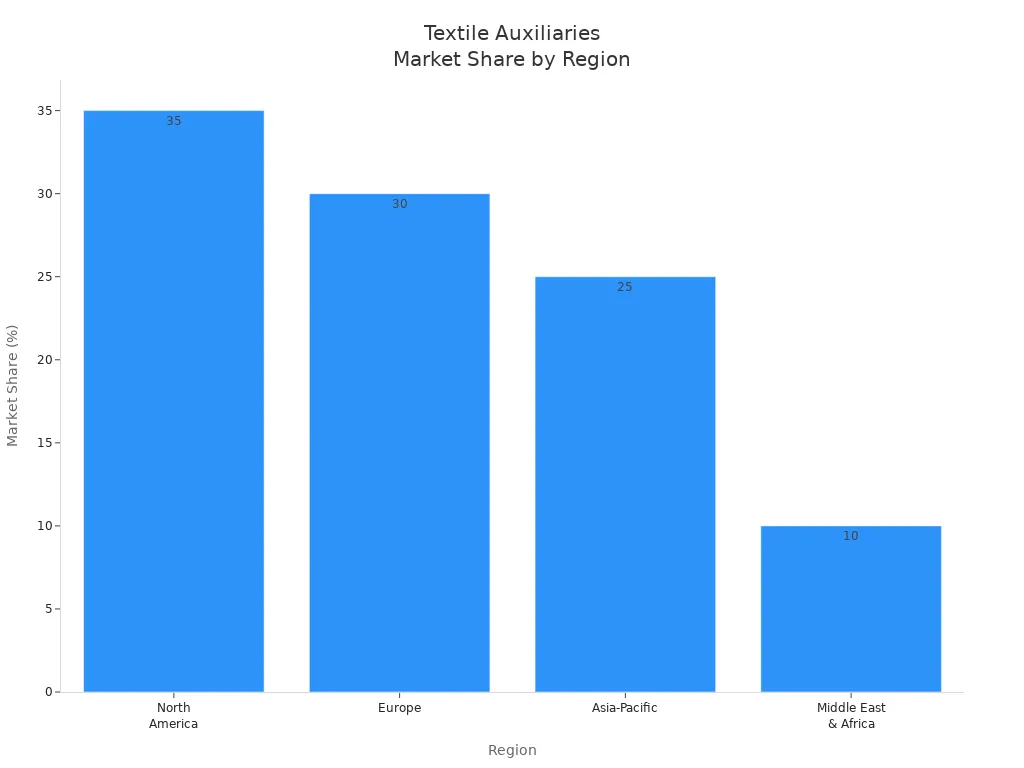
North America has 35% of the market. People want green products and research is strong.
Europe has 30%. They follow strict rules and make new textile ideas.
Asia-Pacific has 25%. Factories grow fast and incomes rise. TIANKUN CHEM helps here with smart solutions.
Middle East & Africa has 10%. They buy good products and get help from governments.
Regional focus helps companies make products that fit local needs.
Innovation and sustainability are important for the future. Companies use less water and harsh chemicals now. They choose biodegradable options instead. New technology gives textiles cool features like self-cleaning and mosquito protection. Tougher rules make companies use safer and greener chemicals.
Aspect | Description |
|---|---|
Focus on Sustainability | Companies move toward biodegradable auxiliaries and eco-friendly production. |
Technological Advances | Innovations add new functions to textiles, improving performance and safety. |
Regulatory Compliance | Stronger rules require manufacturers to adopt sustainable solutions and meet global standards. |
TIANKUN CHEM leads with green dye solutions and quick help. They help clients reach quality and eco goals. Their work shows the industry wants safer and better chemicals for the future.
Picking the best textile chemical formulators means checking product quality first. Top suppliers use strong quality checks to keep chemicals the same. They test if chemicals work well with different textiles. This makes sure results are good. Many companies teach workers how to use auxiliaries the right way. Watching production numbers helps find problems and keep quality high.
Get auxiliaries from trusted suppliers to stop production problems.
Test if chemicals work well with certain fibers.
Teach workers often about how to use chemicals.
Watch production data to find patterns and make quick fixes.
Good support and service make top textile chemical formulators special. Companies should pick partners who give fast technical help and answer quickly. The table below shows important things to look for:
Criteria | Description |
|---|---|
Product Quality | Same good quality every time |
Compliance | Safe and follows product rules |
Technical Support | Strong help with technical problems |
Innovation Capabilities | Works with you to make new ideas |
Professional Experience | Has the right skills and experience |
Quality Control | Uses ISO 9001 and checks quality |
Environmental Compliance | Has real certificates for green standards |
Business Integrity | Acts with honesty and responsibility |
Market Recognition | Products known for being steady |
Innovation and Response Capability | Can make new things and answer fast |
TIANKUN CHEM is known for fast technical help and good solutions for customers all over the world.
Sustainability is very important when picking textile chemical formulators. Companies should check if suppliers follow rules like REACH and OEKO-TEX. These certificates show chemicals are safe and made with care for people and nature.
Picking green suppliers makes products better and helps the business grow for a long time.
Green ways help follow rules and keep the earth safe.
Every company needs different things. Textile chemical formulators should give custom options, work with old machines, and follow world rules. The table below shows key things to think about:
Key Properties | Description |
|---|---|
Customization | Special formulas for your own needs |
Compatibility | Works with your machines and ways of working |
Compliance | Follows REACH, ZDHC, and GOTS rules |
Environmental Considerations | Uses chemicals that break down and are APEO-free |
TIANKUN CHEM gives flexible answers that fit many business goals. This makes them a good pick for textile makers.
The top 10 textile auxiliaries manufacturers help the industry grow. They use new ideas and care about the planet. These companies make safe chemicals for textiles. They create eco-friendly chemicals and use smart technology.
They use parts that break down easily and work fast to meet what people want.
Manufacturers spend money on research to keep textiles safe and follow rules.
People in the industry should watch for new trends, rule changes, and more uses in cars and healthcare.
Knowing what is happening helps businesses make good choices and do well as things change.
Textile auxiliaries are chemicals used in making fabrics. They help with dyeing, washing, and finishing. These products make fabric softer and stronger. They also make colors brighter.
Picking the right supplier keeps quality steady. It helps factories get products quickly and safely. Good suppliers help factories follow world rules. They make sure production goes well.
Many textile auxiliaries use eco-friendly formulas. These products help save water and cut pollution. They help factories follow green rules. Sustainable auxiliaries keep workers and nature safe.
TIANKUN CHEM gives new dye solutions and strong support. They answer quickly and focus on quality. Customers trust their products for safety and good results.
Factories should ask for certificates like OEKO-TEX or REACH. These papers show the chemicals are safe and follow green rules.