Dyestuff industry experts
ITMA AISA 2026



- Home
- About
- Online Q & A
- Products
- Applications
- Solution
- Service
- Our Brand
- Info
- Contact
Views: 4 Author: Site Editor Publish Time: 2026-06-10 Origin: Site


Modified polyester is a fiber material that chemically modifies traditional polyester by introducing a third or fourth monomer into the molecular structure of polyester (PET).
Common modification methods include:
Third monomer: Sodium isophthalate-5-sulfonate (SIPM)Fourth monomer: Polyethylene glycol (PEG)
Among them:
Adding only the third monomer (CDP) introduces sulfonic acid groups, improving dyeing performance. Adding the fourth monomer (PEG) further improves moisture absorption and dyeing conditions, but affects fiber strength. 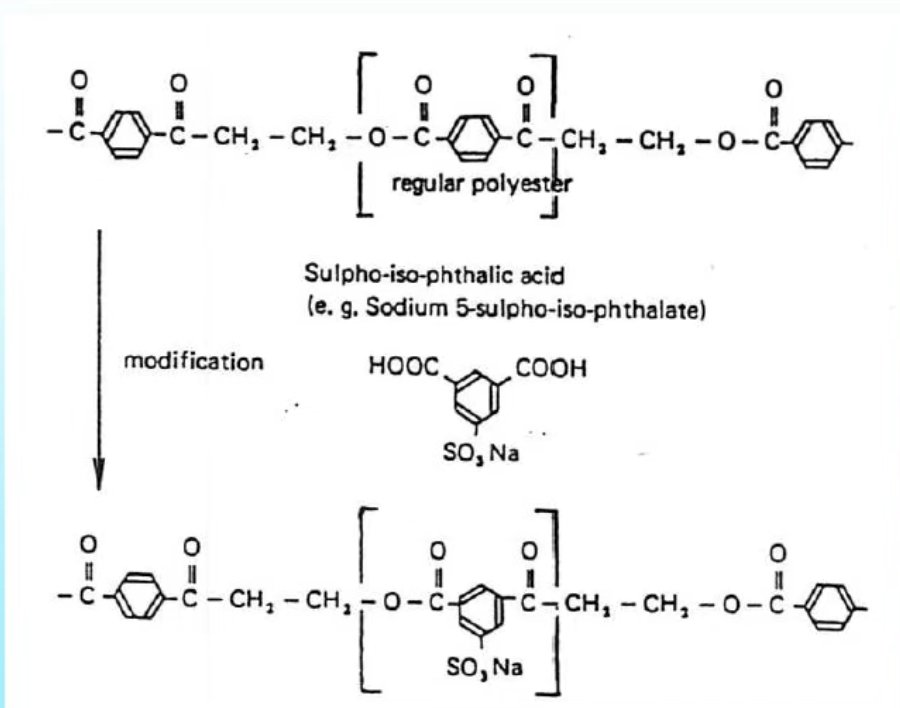
Modified polyester exhibits significant performance differences compared to ordinary polyester:
With only the addition of the third monomer, the accessibility of sulfonic acid groups is approximately 16%, making dyeing still relatively difficult.
With the addition of the fourth monomer:
Dyeing temperature can be lowered
However, fiber strength decreases significantly
Application range is somewhat limited.
Modified polyester offers the following improvements compared to ordinary polyester:
Improved pilling resistance
Increased air permeability
Enhanced moisture absorption
Strengthened antistatic properties
Softer hand feel
Despite significant performance improvements, some engineering challenges arise:
Increased fiber rigidity
Decreased elasticity
Reduced strength
Increased weaving and processing difficulty
Therefore, modified polyester is typically used more in blended fabric systems, such as:
CDP + Polyester
CDP + Nylon
CDP + Acrylic
Modified polyester can use the following dyes:
Catonic dyes (suitable for some modified systems)
Disperse dyes (most commonly used system)
Dyeing temperature usually needs to be close to 120°C.
High-temperature conditions pose a certain risk of fiber decomposition.
Fibers are relatively sensitive to alkali.
Alkali reduction and pretreatment require strict control of process conditions.
Advantages:
Bright colors
Can create multi-color effects
Lighter staining on elastic fibers
High wet fastness
Disadvantages:
Lower light fastness
Poor reproducibility
More pronounced ring dyeing phenomenon
Unstable fiber saturation value
Susceptible to hydrolysis (especially under strong acid/alkali conditions)
Modified polyester is widely used in the following areas:
Sportswear, Casual wear, Lining materials, Socks, School uniforms, Carpets, etc.
Pretreatment is crucial for ensuring dyeing uniformity and stability.
Chemicals: 1 g/L Dyamul GS new, 2 g/L Sodium Carbonate
Conditions: 20 min at 70°C
Purpose: Removes spinning oil, improves wetting, and prepares the fabric for uniform dyeing.
Chemicals: 1–2 g/L Dyamul SLX
Conditions: Slightly acidic, 20 min at 80°C
Purpose: Removes silicone on spandex, reduces internal fabric stress, improves hand feel, and prevents wrinkles during subsequent processing.
Setting time: 30-45 seconds, 160-180°C. Excessive setting temperature or time will damage fibers, affecting dyeing performance and causing yellowing. Fabrics containing spandex can be set up to 190°C; the setting temperature should be kept as low as possible.
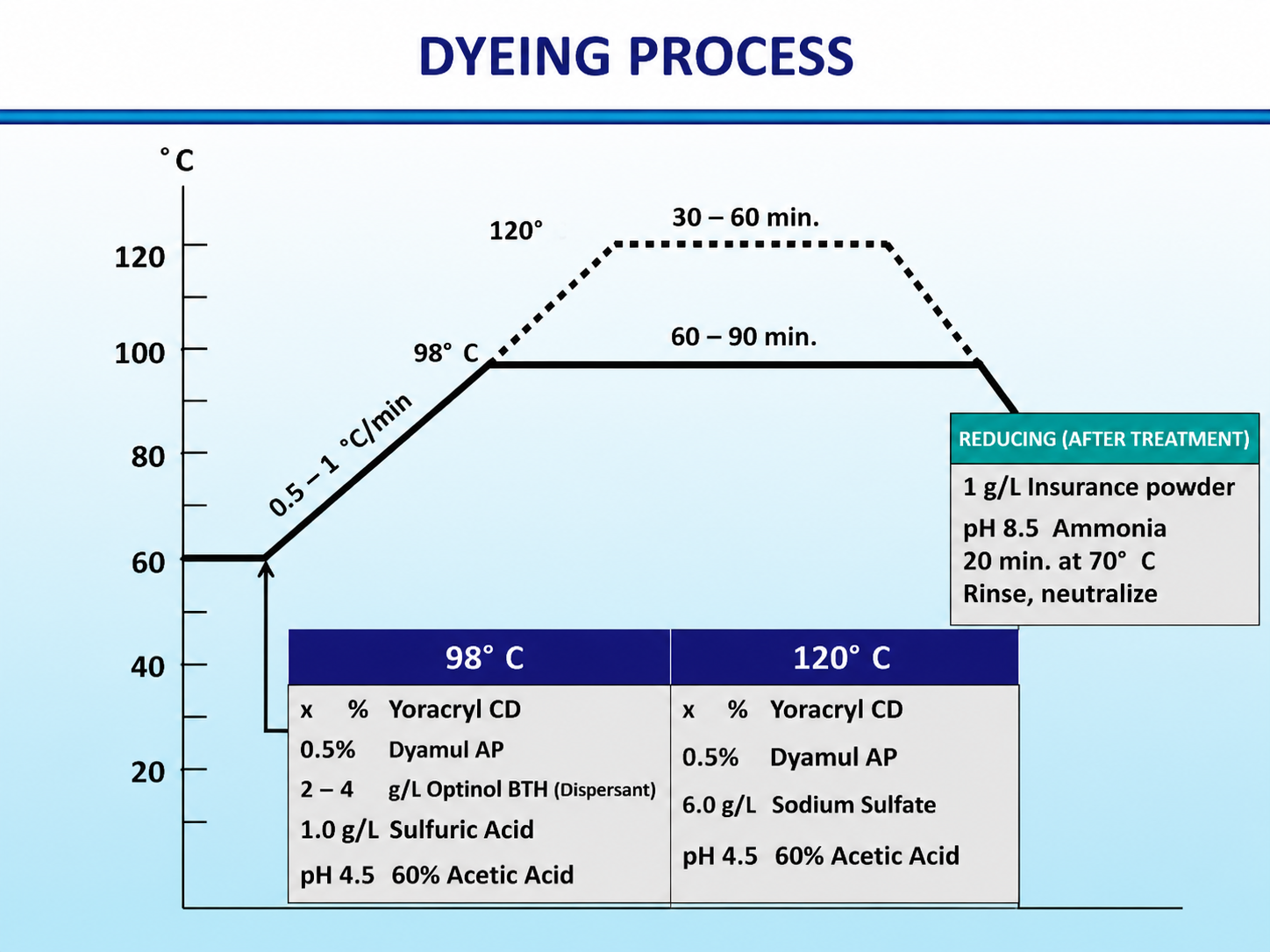
uses water below 50°C. After adding the dye, stir thoroughly until there are no precipitates or lumps, then add it to the auxiliary tank. Do not use hot water above 50°C – it will damage the dye dispersion. Do not add glacial acetic acid to pre-dissolve the dye – it is unnecessary.
Reason: In Skyzon SD dye production, the addition of dispersants forms a precipitated cationic dye, which is an aqueous dispersion.